This Must Be The Podcast: Rana Khoury
I'm delighted to announce the launch of the fifteenth (!) season of the Middle East Political Science Podcast! For over a decade, I've been hosting authors of new books and articles in the field to talk about their research – 290 episodes heading into the new season. Last season, we aired thirteen episodes, with authors including Erik Skare, Diana Greenwald, Scott Williamson, Yasmin Moll, Alissa Walter and more. It's one of my favorite parts of the sprawling web of POMEPS activities. We had to put it on hold in the fall, but we are back today with the beginning of a full new season of conversations with authors of new books in the field.
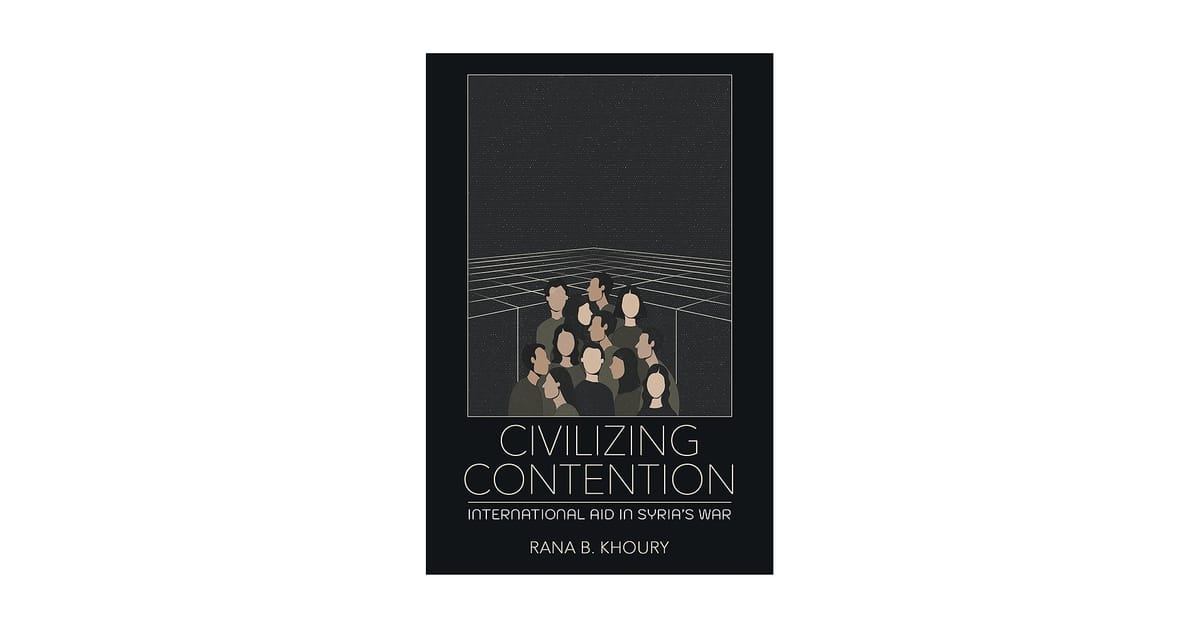
The launch episode of the new podcast season, episode 291 overall, features Rana Khoury of the University of Illinois at Urbana-Champaign and her new book, Civilizing Contention: International Aid in Syria’s War. Khoury explores the shift by many young Syrians from activism in the early days of the uprising against Bashar al-Assad to humanitarian work both inside Syria and in the diaspora. Her innovative research challenges easy dichotomies between activist and aid worker and labels such as "refugee." Like Charlotte Khalil's wonderful recent book Waiting for the Revolution to End, Khoury shows how young Syrians move in and out of activism, change locations and professions, and try to live their lives in the midst of uncertainty and loss.
She shows how understanding civilian and refugee activism in war requires understanding the competing incentives and objectives of the many international actors and organizations that enter the scene to help. Those organizations often rely on local actors to identify needs, facilitate operations, and deliver aid (for another deeply researched study of the varying efficacy of such operations, see Dipali Mukhopadhkay and Kimberly Howe's Good Rebel Governance which we discussed on the podcast a couple of years ago). Activists driven from active protest by the brutalities of war and the inexorable shift from peaceful protest towards armed insurgency dominated by jihadists of various stripes. In contrast to the literature which bemoans the "NGO-ization" of activism, Khoury shows how they facilitate the activists’ participation in something like a civil society even in the depths of war. Yet as aid imposes its structures and routines, it also leaves activists unprotected from the violence of war and its aftermaths – especially as aid organizations with a global remit move on to the next catastrophe.
Khoury is part of an astonishingly gifted, dedicated and productive cohort of emerging scholars who have pioneered ethical research methods in their work on Syrian refugees and migrants (just the ones who have written for POMEPS on the topic include Rawan Arar, Ann Marie Baylouny, Reva Dhingra, Lillian Frost, Ali Hamdan, Shaddin Almasri, Lama Mourad, Kelsey Norman, Elizabeth Parker-Magyar, Wendy Pearlman, Emily Scott, and Baselius Zeno – and there are so many more I could mention). That's important because those refugees are extremely vulnerable and marginal populations who are also the subject of a high degree of geopolitical interest – creating troubling incentives for researchers to do exploitative and potentially harmful research. Khoury's work models how to engage with such populations in an ethical, sensitive, and productive way to produce first rate scholarship.
Listen to the whole conversation with Rana Khoury here:
In the introduction to the episode, I talk about the impressive outpour of rigorous, impassioned and innovative scholarship that has already been produced about the late years of the Assad regime and the transition which began last December with his overthrow. Most of those have been featured here on the MENA Academy blog, and I've collected them all here in one place for you to check out if you want to explore the topic.
Major collections of scholarship reflecting on Syria after Assad:
(1) POMEPS Studies 57: Syria After Assad
(2) APSA MENA Politics Symposium on Syria After Assad
(3) Journal of Democracy special section:
“Forever Has Fallen”: The End of Syria’s Assad, Lisa Wedeen
Why Syria’s Civil Society Is the Key, Rana B. Khoury and Wendy Pearlman
Rebuilding the State in Post-Assad Syria, Daniel Neep
(4) Omar Dahi, How Syria’s Dynasty Collapsed, Current History
(5) The Syrian Studies Association Bulletin new special issue.
Set of articles about Syrians abroad, the topic of Khoury’s book:
(1) Antea Enna, “‘The threat of forced return is the government’s last resort’: structural, cultural, and direct violence towards Syrian refugees in Lebanon,” Journal of Refugee Studies (November 2025).
(2) Bayan Arouri, “(In)accessible refugee camps: insights on localizing knowledge production,” British Journal of Middle Eastern Studies (November 2025).
(3) Kate Pincock, Nicola Jones and Sarah Al Heiwidi, “‘My view of the world and my place in it has been shaken’: shifting political identities among young refugees in Jordan since 7 October 2023,” Ethnic and Migration Studies (November 2025).
(4) Ali Hamdan, “Fieldwork in precarious times: Reflecting on ‘dangerous fields’,” Qualitative Research (November 2025).
(5) Konstanin Ash and Kevin Mazur, “Ethnicity and Strategic Repression of Protest during the 2011 Syrian Uprising,” Perspectives on Politics (October 2025).
(6) Manal Al-Natour, “Intellectual and Creative Paradigms: Syrian Women Resistance Approaches,” Journal of Middle Eastern Women’s Studies (October 2025).
(7) Araa al-Jaramani and Moosa ElAyah, “Voices of resilience: Civil society and community perspectives on gender-based violence in conflict-affected Syria,” Mediterranian Politics (November 2025).
(8) The Arab Center released the results of a major new survey of Syrian public opinion
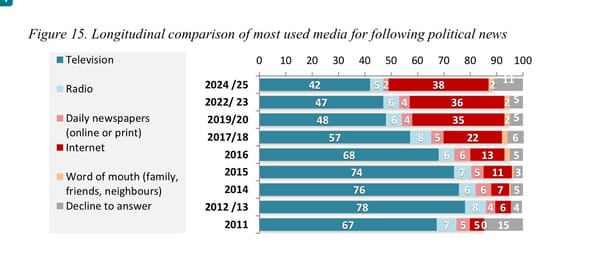
(9) Arab Barometer survey on Syria
(10) Samer Abboud, “Business elites, private security companies, and conflict management in Syria,” Conflict, Security and Development (July 2025).
(11) Marika Sosnowski, “The bureaucratic revolution: the Syrian opposition’s civil registry system,” Third World Quarterly (June 2025).
(12) Emily Scott, “Negotiating for Autonomy: How Humanitarian INGOs Resisted Donors During the Syrian Refugee Response,” Perspectives on Politics (June 2025).
(13) Sectarianism and Civil War in Syria, edited by Raymond Hinnebusch and Morten Valbjørn
(14) Syria Studies has an outstanding new issue, “Trends in Syria Studies at a Time of Internal War”.