IR Theory and the Middle East at War
The last two and a half years have challenged some of the most enduring assumptions about Middle Eastern order in the field of International Relations of the Middle East. The US-Israeli attack on Iran on February 28, followed by Israel's re-invasion of Lebanon, Iran's weathering of the initial regime change attempt and its ferocious retaliation against the Gulf states and the closure of the Straits of Hormuz, forced – or, at least, should have forced – IR theorists to seriously rethink their assumptions, theories, and models. And that was only the latest in a long series of surprises – from the Hamas attack on Israel in October 2023 to the Israeli decapitation of Hezbollah a year later to the sudden collapse of the Asad regime in Syria... and so much more.
To me, it feels like we are watching in real time the collapse of the Middle East which America designed and dominated since 1991 (about which I wrote a book which more of you need to buy ASAP which in my humble opinion predicted much of what's now happening – including a sustained argument that we were entering America's Suez moment, a phrase which at the time I was criticized for using as hyperbolic and which is now becoming rather popular). But not everyone agrees. Nor should they – this is a moment of extreme fluidity, when an exceptionally wide range of outcomes seems possible. The outcome of the war might still ultimately be the consolidation of a much more open and robust military alliance between Israel and many Arab states under American leadership and the strategic defeat of Iran – just as it could still be the strategic victory of Iran, the departure of Gulf states from their alliance with the United States, and the end of US primacy in the region. We are all struggling to keep up with the frantic pace of events, information is tightly controlled (and often swarmed by disinformation and AI-generated fakes), and it's too soon to even talk about "outcomes" in any meaningful sense.
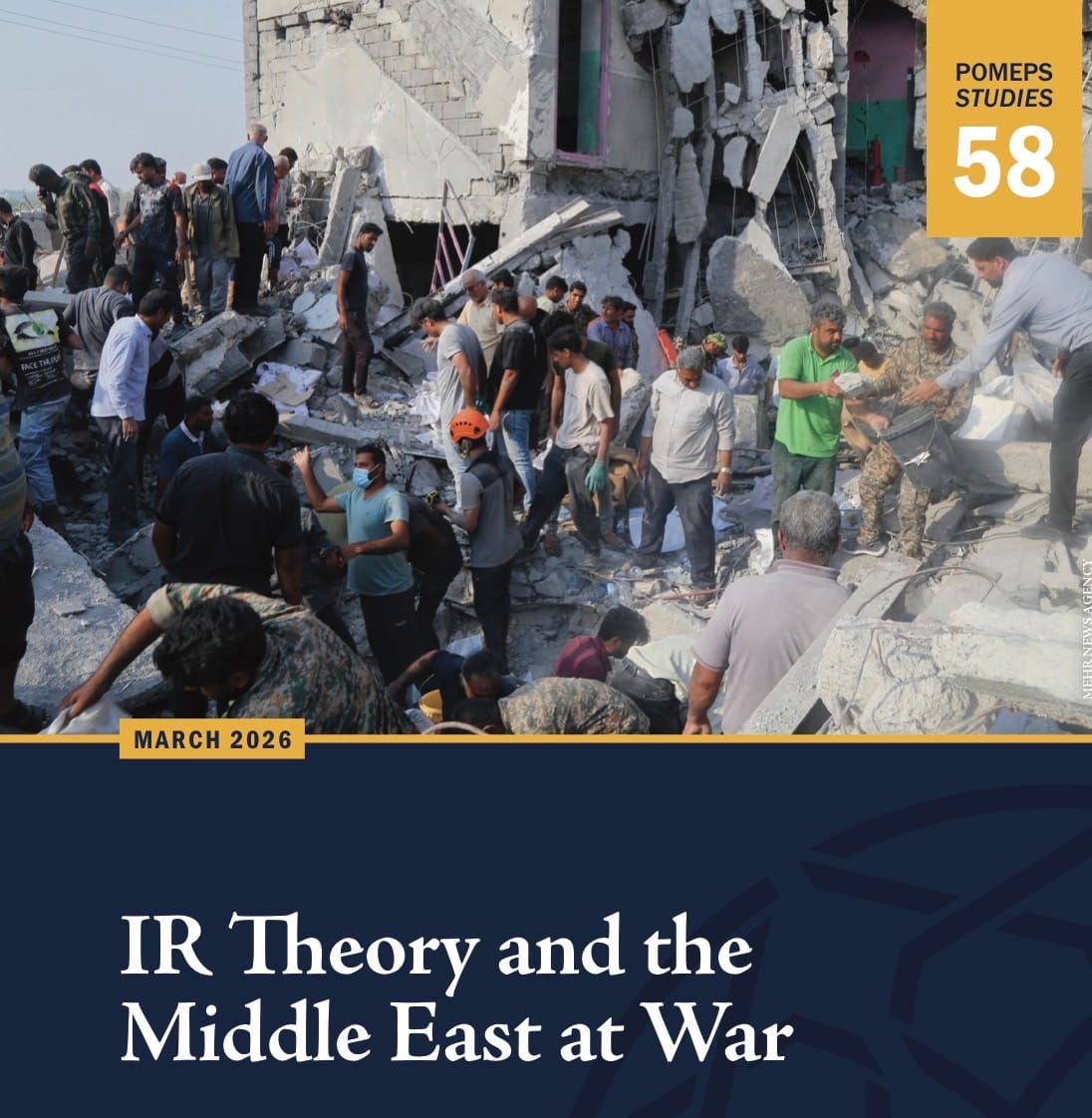
In December 2025, Morten Valbjørn and I hosted a POMEPS workshop at Aarhus University (Denmark) to begin a sustained conversation about whether and how to rethink IR theory in light of these remarkable developments. The papers were written well before the current war. We did not try to force the authors to keep up with the headlines, since the goal was more to interrogate the foundations of key theoretical approaches and causal mechanisms to see which still held and which needed updating. I'm delighted to announce the publication of those papers as POMEPS Studies 58: IR Theory and the Middle East at War (free download at the link). I am reproducing Valbjørn and my framing essay here in its entirety; all the other essays can be found at the link.
IR Theory and the Middle East at War: Challenges and Opportunities
Marc Lynch & Morten Valbjørn
The last couple of years in the Middle East have produced a range of surprises, both unanticipated events and unfulfilled predictions. In late September 2023, US National Security Adviser Jake Sullivan famously described the Middle East as quieter than it had been in two decades, lavishing praise on his administration's management of the region and confidently predicting progress towards normalization between Saudi Arabia and Israel. On October 7, Hamas shattered that calm with its shocking attack on Israel, one that Israel had considered virtually inconceivable. In the ensuing weeks and years, Israel surprised many observers by going beyond a punitive bombing campaign and instead launching a bloody, destructive and ultimately near-genocidal scorched earth invasion of Gaza. Few could have anticipated the Trump administration's move to use plans for the administration of post-ceasefire Gaza to establish the "Board of Peace" as an alternative to the United Nations.
The surprises did not end with Gaza. Observers were again shocked by Israel's sudden offensive against Hezbollah in November 2024, a bolt from the blue which comprehensively decapitated the organization, killed its top leaders, injured large numbers of its fighters (and their families and neighbors), dramatically degraded its vaunted missile arsenal, and largely removed Iran's most dangerous deterrent threat virtually overnight. Few expected that the Houthis would launch missiles at Israel and effectively blockade Red Sea shipping over Gaza or shrug off Israeli and American air strikes against them. Virtually nobody expected the sudden toppling of the Assad regime in December 2024, following nearly a decade of frozen conflict, at the hands of Hayat Tahrir al-Sham, formerly the Al-Qaeda branch in Syria, or the welcome the new very recently jihadist leaders would find in Riyadh, Davos, and Washington. The Israeli air strike targeting Hamas leaders in a residential area of Doha, which violated Qatar’s sovereignty, also caught most observers by surprise. Furthermore, virtually nobody anticipated the sudden December 2025 eruption of regionwide conflict between Saudi Arabia and the UAE, long very close partners in regional politics.
Few anticipated the shift from indirect to direct confrontations involving ballistic missiles and drones between Israel and Iran in 2024, nor Israel’s first major direct air campaign against Iran in June 2025, nor the Trump administration’s dramatic intervention twelve days later deploying an arsenal of bunker-buster bombs intended to destroy Iran’s Fordow nuclear facility—or its failure to achieve that goal. Many actors, having perhaps learned the wrong lessons from the twelve-day war, failed to anticipate Iran's attack on the Gulf states and oil shipping in response to the US-Israeli attack in February 2026, or the regime's resilience against regime change attempts. After decades of debating whether or not to bomb Iran, it was surprising indeed that the Trump administration apparently had no plans for an Iranian move to close the Straits of Hormuz or to defend the Gulf states against sustained missile and drone attacks.
At the same time, some widely held predictions did not come to pass. For all the outrage among Arab publics, there were no serious regime-threatening protests. No regional regime broke its alliance with the United States, seriously downgraded its relations with Israel or intervened militarily in defense of Palestinians. Saudi Arabia, which had seemed more than ready to normalize with Israel prior to October 7, did move in the opposite direction, suggesting that public attitudes still hold some weight. China, despite a decade-long expansion of its diplomatic and economic presence in the region and prophesies about a growing Chinese role in the Middle East, disappointed many regional players by declining to get involved in any serious way, even when the Houthis blockaded Red Sea shipping.
What should scholars of the International Relations of the Middle East make of these surprises? The unforeseen surprises and unfulfilled predictions alike offer a fascinating collection of new evidence to assess competing hypotheses about the nature of regional politics. The literature on the IR of the Middle East has made great progress over the last decade by carefully specifying its theories and identifying expected behavioral implications. Some of these proved prescient, while others did not. Today there is arguably greater fundamental uncertainty about basic principles of regional order than at any point in recent memory. The range of possible outcomes -- from Iran emerging from the war stable and stronger than before to the complete fragmentation of Iran as a state, from the US emerging in command of an open and robust military alliance including Israel and the Gulf states to the complete collapse of the post-1991 American alliance with the Gulf states -- goes beyond more typical degrees of variation. How are actors in the region dealing with this uncertainty -- and how should Middle East IR theory?
Despite the opportunity for theory testing and theory building over the last two and a half years, there has thus far been remarkably little academic stock-taking in comparison to the vast outpouring of such internal critique which followed each of the major surprises which have punctuated the region roughly once a decade. The 1967 and 1973 wars resulted in the production of serious analysis of the end of pan-Arabism, the logic of strategic surprise, the flaws of deterrence theory, and the nature of the interplay between regional and global powers. The 1979 Iranian revolution inspired a vast body of new scholarship on Islamism, revolutions, social movements, and the flawed assumptions which had gone into relying on the Shah as a pillar of stability. The 1990 Iraqi invasion of Kuwait had prompted a serious rethinking of the nature of regional politics, and in short order gave way to a vast new literature on US primacy, the peace process, and the utility of sanctions. The 2003 US invasion of Iraq produced an enormous volume of retrospectives on what had gone wrong. Most recently, the 2011 Arab uprisings spawned a genuinely impressive volume of self-reflection across the field about the alleged failure to predict them, alongside an equally impressive outpouring of new theoretical and empirical development.[1]
There has been so far relatively little comparable intellectual production interrogating the dramatic changes, rampant uncertainty, and unfulfilled predictions since October 7. Perhaps this is a justifiable absence, because there has not been enough time or intellectual space for reflection, or because the surprises were not so significant nor the new developments so radical as to merit discarding or questioning existing theory. Or perhaps the intense political environment surrounding protests against Israel's war on Gaza pushed scholars to retreat into a defensive shell, avoiding self-criticism when there was more than ample external criticism to deal with, or to focus their energies on activism rather than scholarly self-reflection.[2]
Whatever the case, in December 2025, POMEPS convened a workshop at Aarhus University in Denmark, bringing together scholars to collectively interrogate these questions. What core concepts, theories, or hypotheses in Middle East IR require rethinking in the light of October 7 and its aftermath? What changes, if any, are needed in how we study the Middle East? Does Israel's rapid expansion of military operations across the entire region and the potential outcomes of another war with Iran represent a change of the regional order, as Raffaella Del Sarto has defined it in another POMEPS collection, or just a more routine evolution within the existing order?[3]
The workshop followed in the footsteps of a workshop hosted at Aarhus University a decade earlier, which had brought American, European, and Middle Eastern IR theorists into close dialogue about the field, and more recently built upon a POMEPS workshop on regional order hosted a year earlier at the European University Institute in Florence, Italy.[4] This volume of POMEPS Studies collects papers from the Aarhus workshop, which interrogate a wide range of concepts: US primacy (Sean Yom), deterrence (Waleed Hazbun), balancing and underbalancing (May Darwich), the Arab public sphere (Sune Haugbølle), sanctions (Hana Attia), the drivers of Hamas's decision to attack Israel (Jeroen Gunning), the role of ideology in Iran's foreign policy (Eshan Kashfi), Iran's relationship with its regional allies (Marie-Louise Clausen), Saudi involvement in Lebanon (Anne Kirsten Rønn), and the penetration of the region (Massimo Ramaioli and Francesco Cavatorta).
In this framing essay, we lay out our own thoughts on some key thematic areas where events since October 7 have opened up opportunities for rethinking key theories, hypotheses or mechanisms:
(1) Hegemony: The region has for decades been defined by a rough balance of power between the US led axis encompassing Israel and most Arab states on the one hand, and Iran and its regional axis of resistance on the other. As Yom notes in his essay, US primacy remains unchallenged despite perceptions of its decline (at least at the time of writing). With the destruction of Hezbollah and the attempted toppling of the Iranian regime, some Israelis aspire to a Pax Hebraica, regional domination based on unfettered military superiority and unconditional alliances with Arab states along the model of the Abraham Accords. Can Israel, with US backing, impose such a new regional order through airpower? Which states in the region would join such a new regional order, and on what terms? Would Arab states continue to "underbalance", as Darwich discusses in her essay, or would they see the need for more assertive policies to protect themselves in a new environment. Would this simply be a new iteration of long-standing US primacy, or would it be disruptive of that primacy because of Israel's divergent interests and priorities? What kind of hegemony would it be, in the absence of any of the normative foundations or ideational appeal which theories of hegemony typically claim to be necessary?[5] How stable and enduring would it be? Why would rising Israeli power not trigger a balancing coalition rather than submission -- and was the new Saudi-led alliance which emerged just before the US-Israeli attack on Iran early evidence of such balancing? A vast literature has emerged recently on hierarchy and gradations of hegemony within which the Middle East has been oddly marginal. Recent developments offer a prime opportunity for Middle East IR theory to join these debates about the relative importance of hard power and normative legitimacy, the complex politics of elite networks, the logic of balancing and bandwagoning, the tensions between top-down order building and internal rivalries among those being ordered, and the implications of growing or narrowing gaps between leaders and their populations.
(2) Deterrence and War: As Hazbun notes in his contribution to this collection, deterrence has long been at the heart of regional stability. But the events of the last few years should have badly shaken our confidence in the stability of deterrence. Simply calculating the real balance of power is increasingly challenging. While Israel and the US have decisively demonstrated their ability to dominate the air and bomb at will, their unwillingness or inability to deploy ground forces has limited their ability to dictate outcomes. Meanwhile, Iran's relatively cheap missiles and drones, and ability to target oil and gas production and shipping, have demonstrated an ability to compensate for weakness in the traditional forms of military power. Iran's proxies, such as Hezbollah, even in its weakened state, and the Houthis, offer force magnifiers of genuinely uncertain value when their deployment is ultimately a choice made by nominally independent actors with their own self-interests. Israel's decapitation of Hezbollah allowed it, at least for a time, a much wider margin of freedom to act by removing that deterrent threat. Iran's retaliation in the twelve-day war clearly did not suffice to restore it. Iran, for its part, maintains its graduated response during the twelve-day war was neither understood nor rewarded, and now likely believes that the only way to re-establish deterrence is to impose so much pain on Israel, the US and the Gulf that they will never again attempt an attack of this kind. Would regional order be better served by the disappearance or the reassertion of deterrence?
(3) Leadership Decapitation: The Israeli attack on Hezbollah and the US-Israeli attack on Iran have normalized the practice of assassinating the top leaders of adversaries. This is a stark change in not just regional but global practice -- even in recent wars as heated as Russia-Ukraine - as well as international law. What are the implications of the routinized killing of the leaders of rival states? Can such practices really be restricted to American-Israeli enemies, or will it evolve into a new norm in the region and more broadly -- and what would be the argument against counterstrikes against American, Israeli, or Arab leaders? Will such a new norm be destabilizing, as leaders expecting to be killed in the first moments of war are incentivized to launch first? And how will it affect the ability of successors to the assassinated leaders to impose order and sustain a rational war strategy?
(4) Regional Security Architecture: The Middle Eastern regional order for decades has been built on the architecture of Israeli-Arab cooperation under US auspices against Iran. How will the US-Israeli war on Iran impact that regional order? The US and Israel have demonstrated great military power and battlefield supremacy, but have been unable to achieve rapid victory, defend completely against Iranian retaliation, or quickly topple its regime. What conclusions will allies and adversaries draw about US and Israeli power and reliability? What if there actually were a successful regime change that ends the Islamic Republic and produces something more transformational than an IRGC-led autocracy? How would a new Iran fit into regional architecture? Would it return the region to the days of the Shah, as a reliable and powerful autocratic American ally, or would it produce a new form of nationalist independence as challenging to American order as the Islamic Republic? Would it seek to balance against the power of a dominant Israeli-Gulf bloc or shelter under its umbrella? What would hold the US order together without an Iranian threat? How will the highly evident and profound doubts Gulf leaders and publics now express about the value of American bases and security guarantees affect their alliance choices and calculations? How will those regimes respond to Israel's demonstrated willingness and ability to strike at will across the region, which could well threaten them in the future?
(5) Regime Security Theory: The dominant analytical position within Middle East IR in recent years has been regime security theory, the argument that regimes in the region will prioritize any threat to their own survival, whether internal or external, ideological or material.[6] There has certainly been some of that on display, but overall, regimes seem less concerned about their survival in the face of internal threats than they have in the past -- or than they probably should be, given the accumulated pressures of a decade and a half of repression and the added systemic shocks since October 7. Have regimes finally moved on from 2011 and no longer perceive existential threats to their survival? Is that because of upgraded authoritarianism and improved repression or something else? Or is it simply because the intensity of external hard power threats requires a focus on traditional forms of security, while perhaps driving the kind of rally around the flag effect that temporarily pushes even the most disgruntled citizens into patriotic supporters of their leaders?
(6) Foreign Policy Analysis: Much IR theory is inherently structural, privileging broader forces such as the balance of power, collective identities, or regime survival over the role of individuals. Political psychology approaches, feminist theory, and some strands of foreign policy analysis have paid more attention to the importance of individual-level decision-making, cognitive biases, and personal characteristics.[7] Developments since October 7 seem to offer important new examples to advance that literature. The overwhelming importance of Trump's personal qualities and pursuit of individual self-interest in driving US policies has been accentuated by the relative impotence of both domestic and international institutions. Bargaining theories of war struggle with figures like Trump, who does not seem to believe he will pay the predicted costs for actions and is extremely risk-acceptant - but may now be confronting reality in the Straits of Hormuz for the first time in his life. Meanwhile, the assassination of top individual leaders such as Hassan Nasrallah and Ali Khamenei does not seem to have had a massive impact on the behavior, power, or organizational coherence of the regimes they led.
(7) Proxy Wars: The structure of regional power politics over the last decades has heavily rested on indirect proxy warfare across the landscape of shattered and weakened states, as Kashfi, Clausen, Rønn, and Ramaioli and Cavatorta each discuss in their essays.[8] Israel's direct military actions since October 7, and the sudden weakening of most of Iran's Axis of Resistance, seem to have shifted us back into a world of direct military conflict. Does that reduce the salience of proxy warfare and nonstate actors, or should it be read in a more cumulative way? Does direct warfare return us to the logic of deterrence theory, or does the recent destruction of Hezbollah and Israel's failure to deter Hamas suggest that deterrence theory itself needs to be re-examined? Would the serious diminution of Iranian power, or a change of its regime, increase or diminish the importance of its erstwhile non-state partners across the region? How should we understand the decisions made by the Houthis, Hezbollah, and various Iraqi militias with regard to joining Iran's war effort against the US and Iran? Are they calculating their own self-interest based on local context or fighting Iran's war on its behalf?
It is possible to make two very different arguments looking forward. One would be that non-state actors and their supporters are weakened, and as a consequence, regional rivalries will become more aligned with what conventional IR theory would predict in terms of inter-state conflicts and rivalries; the direct clashes between Iran vs. US/Israel with limited role for non-state actors could be an expression of this. On the other hand, one could also argue that we should expect to see more proxy warfare in the coming years as states continue to fracture and competition to define regional order accelerates. State failure in Iran would offer a huge pool of non-state actors to be dragooned by various external actors with unpredictable effects -- reported US plans to arm Iraqi Kurds to invade Iran could be only the beginning.
(8) Region-Making: Could recent events lead to a more fundamental rethinking of the Middle East as a region at all? A key part of regional order building is the definition of the region itself. In recent years, we have seen an expansion of the Middle East's fuzzy borders, particularly in the East African area, where the UAE, Qatar, Saudi Arabia, Iran and Turkey increasingly competed for influence.[9] The Biden administration pushed several transregional concepts, including the India Middle East Corridor and the I2U2 grouping. We have seen a continued blurring of the borders of the Middle East in recent months. Iran has targeted Cyprus in addition to more traditionally Middle Eastern states. Israeli Prime Minister Netanyahu recently previewed a new strategic 'hexagon' alliance featuring India, African countries, Greece, Cyprus, and unnamed Asian countries. Saudi Arabia brought Turkey and Pakistan into its own new strategic alliance. As the Iran war expands and mutates, it seems unlikely to be contained within the traditional borders of the Middle East.
(9) State-Making and State-Breaking: Within the Middle East, we have seen challenges both to state borders and to the meaning of state sovereignty. These are not, perhaps, as brazen as the Islamic State's claim to have "broken the borders" of the Sykes-Picot Middle East with its declaration of a Caliphate spanning parts of Iraq and Syria. But Israel's claimed right to act in southern Syria, support for Druze secessionism, ongoing bombing across the country, and talk of establishing settlements in areas of claimed Biblical provenance all point to a new disregard for state sovereignty. So does its renewed war on Lebanon, which includes reported plans to reoccupy the south and establish a new security zone there, the evident dismemberment of Gaza under the auspices of post-Hamas reconstruction, and Israel's seeming war aim of shattering the Iranian state to encourage secessionist uprisings. There are continuities with Israel's long occupation of south Lebanon and claimed right to strike Hezbollah even north of Beirut, of course. But the trend towards disregard for state sovereignty and the promotion of secessionist or expansionist movements seems clear. The Saudi conflict with the UAE in late 2025 revolved around the latter's alleged support for secessionist movements in Yemen, Somalia, Sudan, Syria, with Saudi Arabia presenting itself as defending state sovereignty and stability to sustain regional order. Could we be entering an era of a fundamental redefinition of state sovereignty and its meanings? What's more, if a regime collapse turns into a state collapse in Iran, then we might expect cascading state failure in Syria, Iraq, Lebanon, and other neighbors.
(10) The Palestinian issue: The Abraham Accords sought to sever the question of regional alliances from the question of Palestine. The evidence from Gaza about the ongoing relevance of linkage is mixed: Arab publics clearly do still care, and Saudi calculations about normalization have shifted, but we saw very little real change in the foreign policies of most states. Does the palpable shifting of US and global attitudes towards Israel and Palestine have significant implications for regional international relations? Does a declining sympathy with Israel across multiple contexts, increasing international isolation, or academic critique matter? If so, then why has Israel continued to enjoy critical support from most European governments and from the United States? If not, why does Israel pay so much attention to combating BDS, "delegitimation" and alleged antisemitism? Competing hypotheses present themselves: the rising salience of Palestine as a normative and identity issue will raise the costs of normalizing with Israel or will reduce global support for Israeli wars; or Israel's impending victory over the Palestinians and the Abraham Accords model are harbingers of the disappearance of Palestine as an issue.
(11) Islamism. The decision by Hamas to attack Israel on October 7 had many logics, as Gunning shows in his essay. But today, Islamist movements of all descriptions lie in ruins. Political Islam has suffered severe setbacks across the region, particularly since October 7, crushed by the weight of state and regional repression and demonized through the course of failed democratic transitions.[10] Iran too has suffered severe setbacks. At the same time, Islamism has proven resilient across decades of surges and setbacks, and it may be premature to write it off as a form of transnational political mobilization.[11] The horrors of Gaza and the impotence of Arab regimes in the face of Israeli expansionism seems to create an opportunity for new forms of resistance, perhaps in different shades of Islamist appeal. Jihadist movements have lost their wars and enjoy little public sympathy anywhere. Even the victory of HTS in Syria, which seems like a counterexample to the thesis of Islamist decline, may prove pyrrhic for Islamism, as Ahmed Sharaa sheds his weapons and combat robes for a sharp business suit and neatly trimmed beard while visiting the White House and basking in applause at Davos. Are we now at last in the “post-Islamist” Middle East which many have anticipated since at least the early 1990s, or on the brink of yet another dramatic revival of Islamist fortunes? What would that mean for the possibilities and modalities of political opposition and resistance?
(12) Gulf economies: Theories about Middle Eastern international relations have long taken for granted the growing centrality of the Gulf states and the general shift of regional power eastward. Iran's targeting of its neighbors during the war and its closure of the Straits of Hormuz could potentially force a fundamental rethinking of these assumptions. How would a long-term disruption of oil and gas production and shipping impact the domestic political economies of the Gulf regimes, their growth strategies, and even their ability to sustain the existing modes of governance? How would such a long-term closure affect their ability to project power within the region or to finance reconstruction projects in devastated zones such as Gaza and Syria? How might such a long disruption, and the potential for it to recur, impact the willingness of Asian and European markets to rely on them for energy?
(13) Climate and the environment: The horrifying images of US-Israeli bombing of Iranian desalination plants and oil refineries, and Iranian threats to retaliate against Gulf counterparts, have made the environmental impact of war impossible to ignore. Iran's closure of the Straits of Hormuz and targeting of Gulf oil facilities quickly drove the oil prices skyrocketing. This may cause a global recession, but the vulnerability of oil dependency could at the same time, in principle, also accelerate the process of decarbonization. At their extreme, these massive, rapid impacts could threaten the very possibility of human life in parts of the Gulf and Iran, areas where climate change already has temperatures surging, water running out, and environmentally driven disease spreading. What the Trump administration derided and de-emphasized as "woke" concerns irrelevant to the hard realities of global power have quickly turned out to be absolutely central strategic issues in the spiraling war. The scholars who have centered climate and environmental issues in the Middle East have an important opportunity to demonstrate the relevance of their research, test long-debated hypotheses, and reshape the policy agenda.[12]
Towards a Rethinking
While these developments point to important changes in regional politics, the jury is still out as to whether it makes sense to speak of the rise of a completely “new Middle East”, or if we instead are witnessing changes in rather than changes of. Here it is useful to recall the late Halliday’s remark that “there are two predictable, and nearly always mistaken, responses to any great international upheaval: one is to say that everything has changed; the other is to say that nothing has changed.”[13]
This serves as more than just a useful reminder of the importance of nuances in the current “new Middle East” debate. It is also relevant to the question of whether Middle East international relations have changed to such an extent that there is a need for a rethink of our past assumptions, approaches, and theories about regional politics. So far, this more inward-looking question concerning the study of regional politics has received less attention than debates on what has (and has not) changed in regional politics since October 7, 2023.
Perhaps it is time to begin engaging in such self-reflection on the broader scholarly and theoretical implications of recent developments in the region. In the spirit of Halliday, such an endeavor should not be framed as a binary choice between whether our theories and approaches have now become completely obsolete, or, conversely, are just as useful as in the past. Instead, we should start by recalling the post-Arab uprisings debate, which evolved from a polarized argument over whether, for instance, theories on authoritarian durability had become completely discredited (after the fall of various autocrats) or vindicated (after the counter-revolutions), to a much more subtle and nuanced discussion seeing to specify what these theories got right and wrong, and how their shortcomings could be addressed or “upgraded” without losing relevant insights.[14]
In a similar vein, the primary task when it comes to our theoretical approaches to Middle East international relations after October 7 is to gain a better understanding of three areas: whether there are new phenomena that existing theories do not address, requiring novel theory development; whether there are phenomena that are well-known, but for which our theories fall short in accounting for how they are currently playing out; and finally, whether there are phenomena for which our existing approaches remain robust. The essays in this collection begin this important mission. But there is much work remaining to be done.
[1] Lynch, Marc, Jillian Schwedler, and Sean Yom, The Political Science of the Middle East (Oxford University Press, 2022); Bank, André & Jan Busse (2021). "MENA political science research a decade after the Arab uprisings: Facing the facts on tremulous grounds". Mediterranean Politics, vol. 26, no. 5, pp. 539-562.
Valbjørn, Morten (2015). "Reflections on Self-Reflections - On framing the analytical implications of the Arab uprisings for the study of Arab politics". Democratization, vol. 22, no. 2, pp. 218-238; Gause, F. Gregory (2011). "Why Middle East Studies Missed the Arab Spring - The Myth of Authoritarian Stability". Foreign Affairs, vol. 90, no. 4, pp. 81-90. Howard, Marc Morjé, Meir R. Walters, Eva Bellin, Ellen Lust & Marc Lynch (2014). "Symposium: Explaining the Unexpected: Political Science and the Surprises of 1989 and 2011". Perspectives on Politics, vol. 12, no. 02, pp. 394-419; Lynch, Marc (ed.) (2014). The Arab Uprisings Explained - New Contentious Politics in the Middle East, New York: Columbia University Press.
[2] The field of genocide studies did not similarly shy away, though - see Dirk Moses's long-running symposium in the Journal of Genocide Research which brought in most of the biggest names in the field. Nor have similarly vulnerable disciplines such as Palestine studies or anthropology.
[3] del Sarto, Raffaella (2025). "Violence and Regional Order in the Middle East since October 7". POMEPS Studies, vol. 56: Regional Order Making after October 7, pp. 17-23.
[4] "International Relations Theory and a Changing Middle East". POMEPS Studies 16 (September 2015); "Regional Order Making after October 7". POMEPS Studies 56 (July 2025).
[5] Gause, F. Gregory (2019). "“Hegemony” Compared: Great Britain and the United States in the Middle East". Security Studies, vol. 28, no. 3, pp. 565-587. McConnaughy, M., P. Musgrave and D. Nexon. (2018). “Beyond anarchy: logics of political organization, hierarchy and international structure.” International Theory 10, no.2: 181-218; Lake, D.A. (2009b). Hierarchy in International Relations. Ithaca, NY: Cornell University Press; Ikenberry, G.J. and D.H. Nexon. (2019). “Hegemony Studies 3.0: The Dynamics of Hegemonic Orders.” Security Studies 28, 3: 395-421.
[6] Ryan, Curtis (2009). Inter-Arab Alliances: Regime Security and Jordanian Foreign Policy, Miami: University Press of Florida. Gause, F. Gregory (2003). "Balancing What? - Threat Perception and Alliance Choice in the Gulf". Security Studies, vol. 13, no. 2, pp. 273-305.
[7] Darwich, May & Juliet Kaarbo (2020). "IR in the Middle East: foreign policy analysis in theoretical approaches". International Relations, vol. 34, no. 2, pp. 225-245.
[8] Salloukh, Bassel F. (2017). "Overlapping Contests and Middle East International Relations: The Return of the Weak Arab State". PS: Political Science & Politics, vol. 50, no. 3, pp. 660-663.Phillips, Christopher & Morten Valbjørn (2018). "‘What is in a Name?’: The Role of (Different) Identities in the Multiple Proxy Wars in Syria". Small Wars & Insurgencies, vol. 29, no. 3, pp. 414-433.
[9] Marc Lynch and Simon Mabon, eds., Order and Region-Making in the Middle East (Edinburgh University Press, 2024); Lynch, What is the Middle East? The Theory and Practice of Regions (Cambridge Elements, Cambridge University Press, 2025); Mohammed Soliman, West Asia (Polity 2026).
[10] See Hafez, Mohammed (2026). "A Waning Crescent: Why the Era of Islamism is Coming to an End". Middle East Journal, vol. 79, no. 1, pp. 57-66.
[11] Lynch, Marc (2022). "The Future of Islamism Through the Lens of the Past". Religions, vol. 13, no. 2
[12] For an introduction, see "Environmental Politics in the MENA," POMEPS Studies 46 (May 2022)
[13] Fred Halliday (2002) A New Global Configuration, in Ken Booth & Timothy Dunne (eds) Worlds in Collision: Terror and the Future of Global Order, pp. 235–244 (New York: Palgrave), p. 235.
[14] Valbjørn, Morten (2015). "Reflections on Self-Reflections - On framing the analytical implications of the Arab uprisings for the study of Arab politics". Democratization, vol. 22, no. 2, pp. 218-238.