Iran, the Gulf, and America's Middle East
"Iran’s bombardment of its Gulf neighbors has inexorably dragged them into a war that they had desperately hoped to avoid. The potential entry of the United Arab Emirates, Qatar, and Saudi Arabia into direct war alongside Israel and the United States represents the first full-scale manifestation of America’s ambitions for the Middle Eastern order it has overseen for decades. Washington has always dreamed of Arab-Israeli cooperation against Iran without resolving the Palestinian issue. Here it is. It would be no small irony if America’s Middle East reached its apotheosis just as the entire region collapsed into the abyss. But that day may be coming. The Gulf states can no longer believe that the United States can or will protect them from existential threats. And even as they are forced to openly cooperate with Israel in its war, they will increasingly view it as a threat rather than a potential ally."
My book America's Middle East explains the ruinous logic of the Middle Eastern order that the United States constructed after 1991, based on cooperation between Israel and Arab autocrats against Iran. That system was rooted not in American coercion, really, but in the self-interest of the rulers of its regional allies, all of whom prioritized staying in power. America's primacy in the region rested on that bargain, in which regional allies kept the oil flowing and protected Israel in exchange for Amerian protection against external and internal threats. When the US deviated from that policy and did things like try to get a nuclear deal with Iran or support democratic change in the region, those allies pushed hard on all fronts to force Washington back onto the traditional path.
My new piece in Foreign Policy (no paywall) explains how the US-Israeli war on Iran is different. The Gulf states feel that the United States has now exposed them to existential risk without serious consultation and with little regard for their survival.
Gulf leaders have good reason to believe that the United States and Israel launched a war, which directly impacts not just their interests but their survival, without serious consultation. They are deeply uncomfortable with the Israeli regime-change strategy, which involves the destruction of Iranian state institutions, since they understand that they (unlike Israel) cannot be immune from the catastrophic fallout. They can hardly believe U.S. impotence at protecting oil installations and shipping, and the United States’ inability or unwillingness to rapidly refresh their dwindling stocks of interceptors. There is a profound sense that U.S. military bases have become a source of threat rather than security.
This insecurity is a shocking realization for a region that has been an oasis of stability and prosperity in an otherwise collapsing Middle East. Iran has, for the first time, shattered the illusions of Gulf citizens about their immunity from regional politics. The wealthy Gulf states and their people had good reason to feel that they were detaching from the region’s problems, that they had more in common with wealthy Asian states than with the shattered Middle East. The human price of regional power politics was supposed to be paid by Syrians, Sudanese, Lebanese, and Yemenis—not by them.
With Israel and the US veering wildly between strategic objectives, bombing with devastating impact but without a clear goal. Gulf regimes have no love for the Islamic Republic, to put it mildly, but they are deeply aware of the risks and costs of either protracted war or of Iranian state collapse – and ever more threatened by Israel's ability and claimed right to strike at will anywhere and any time.
The Gulf states, for the most part, preferred to avoid war, but they recognized that it was inevitable as the U.S. armada assembled and Omani mediators saw the Trump administration was barely bothering to pretend to negotiate in good faith. With war inevitable, the Gulf states hoped to at least shape the campaign’s geography and strategy in ways that would minimize their exposure to its fallout. They hoped for a short war that would replace top Iranian leaders with more pragmatic autocrats, presumably from the military, without shattering the state in ways that would spread instability, refugees, and uncertainty. And they hoped the conflict would remain confined to Israel and Iran, leaving the Gulf states and oil shipping relatively unaffected.
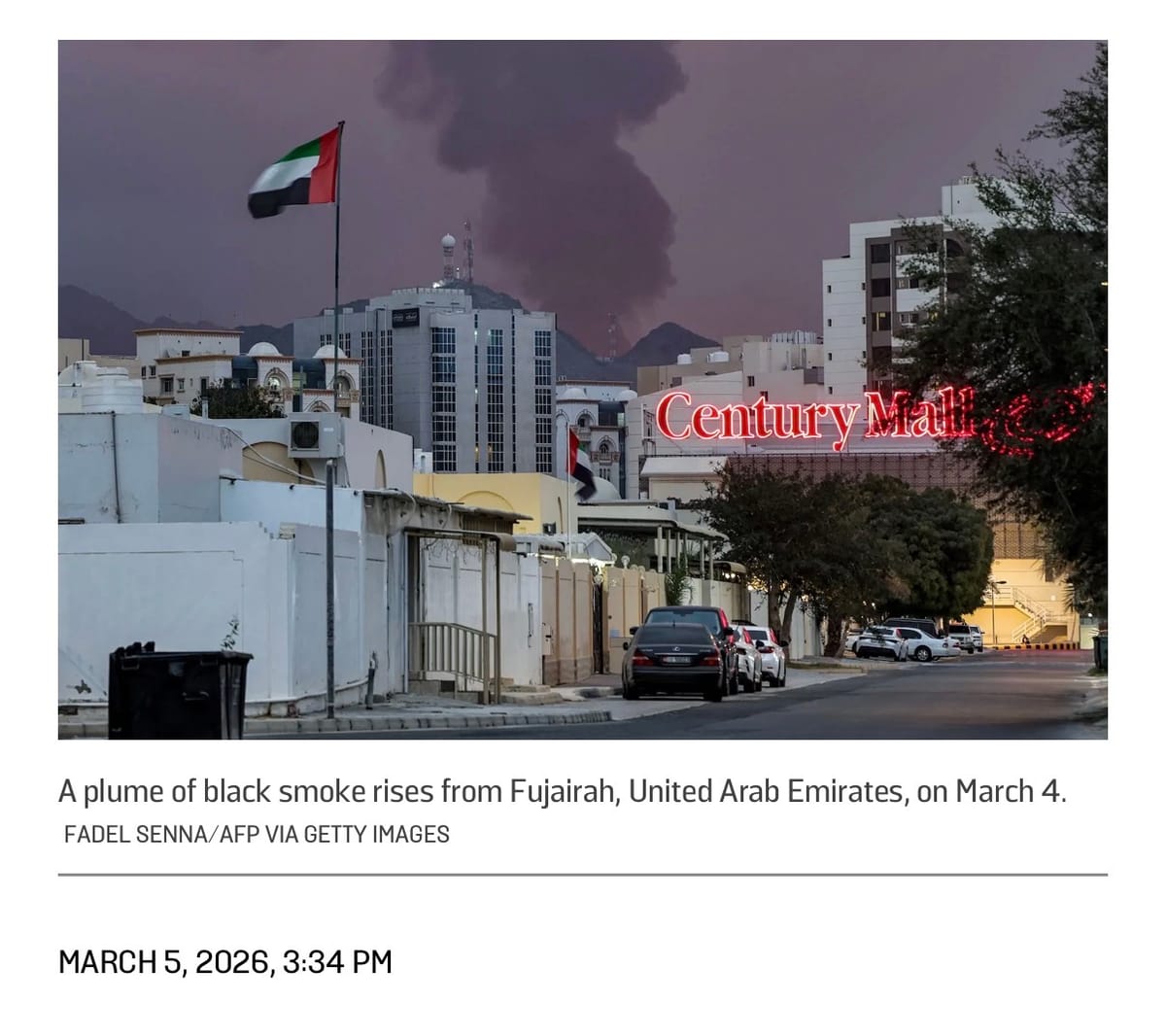
Iran rejected that script, responding to the U.S.-Israeli attack with a massive and escalating bombardment of every Gulf neighbor. The Gulf now is seeing its worst nightmares materialize, because Washington also rejected its script. The article explains Iran's strategy, which seems quite clear and which it has been pursuing systematically and effectively: imposing pain on the global economy by shutting down oil shipping, targeting US military infrastructure including missile defense radar systems, and trying to exhaust US and Israeli missile interceptors with cheap missiles and drones. Attacks on symbolic and civilian targets in the Gulf have a role in this strategy as well – and Iran does not see forcing the Gulf states into closer cooperation with Israel as a loss. There's no good endgame for the Gulf states – and there's a real sense that this will be an historic, pivotal moment in regional order no matter how the war ultimately resolves.
There's a lot more on Iranian strategy, American miscalculation, and the Gulf's predicament. Read the whole article on Foreign Policy.