It's MENA Academy Monday!
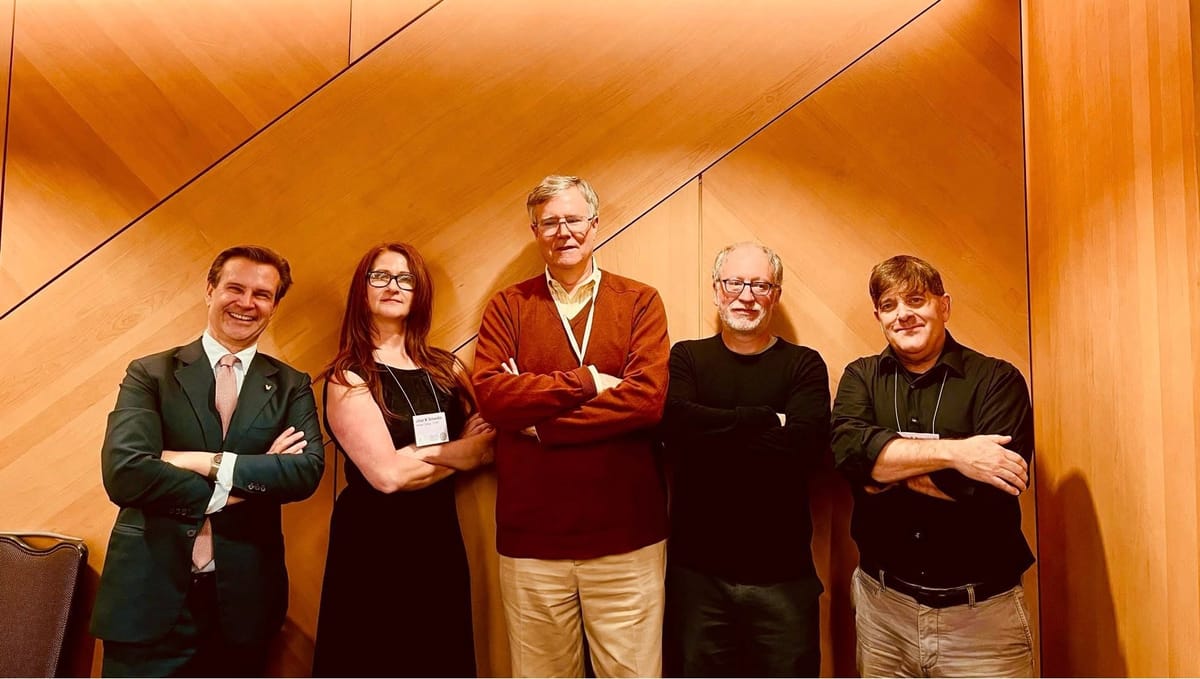
I spent last weekend at the annual meeting of the Middle East Studies Association in Washington DC – the first in-person meeting of MESA in several years, and a much needed one for an embattled academic community. MESA has been absolutely exceptional over the last several years in rising to the defense of Middle East Studies and academic freedom more broadly – issuing countless letters on academic freedom, partnering with the AAUP and Knight on a successful lawsuit over the deportation of student protestors, documenting the abuses of the Title VI program since October 7, and so much more. But it's also still primarily the primary international professional association for the academic study of the Middle East – and even a cursory review of this year's program shows that it plays that role more than ever. Still, I had no idea what to expect from the conference, given Trump's draconian new visa regime and abusive immigration enforcement policies – would scholars from MENA region be able to travel to the US? Would ICE goons attack the conference looking for MENA immigrants to deport?
Those fears were not entirely unrealized: Vahid Abedini, an Iranian professor at the University of Oklahoma (and a valued POMEPS alum) with an HB-1 visa, was arrested by ICE at the airport on his way to the MESA conference for reasons unknown and released only after three days in detention. It's one of the first known instances of such an ICE arrest of a professor legally working in the country, and should be of concern far beyond the Middle East Studies community and not quickly forgotten since he was released or because of latent notions that his Iranian nationality somehow justified his treatment. If academia and broader political society has learned anything from the last two years, it should have learned that attacks on the most vulnerable communities – this time Iranians, Palestinians and protestors against genocide in Gaza before that, or the trans community (as in another troubling UO incident) – are almost always used as a wedge to build capacity and precedent for broader crackdowns on everyone else.
But despite that extremely troubling incident, and the broader fears, the conference was well-attended, vibrant, and more hopeful than scared (I don't know how many people had to back out of the conference, though). At the jam-packed POMEPS reception I heard again and again how grateful people were to convene in person again, to share their experiences and stories and to just catch up with each other. There were important moments of recognition of all that has been lost, particularly the untold tens of thousands of Gazans who have died or had their lives destroyed by Israel's unending war. But there was also determination and hope... and an absolute deluge of creative, novel and engaged scholarship across topics and disciplines.
My own participation in the workshop involved two panels, each interesting in its own way. The first panel was a festschrift for the recently retired Gulf scholar F. Gregory Gause III, based on some of the contributions to a forthcoming special issue of the journal Middle East Law and Governance. Gause is a great friend, with whom I often disagree seriously on policy – the kind of respectful and rigorous disagreement aimed at building knowledge rather than just scoring points or generating viral videos which, as I said in my remarks, has become something of a lost art in our hotly polarized public sphere. My paper revolves around his Foreign Affairs article a few years back, "The Price of Order" advocating setting aside democracy concerns in favor of re-establishing strong and capable states in a collapsing region; I suggest that empowering the existing regimes is the equivalent of putting the arsonist in charge of the firehouse, but you'll have to wait another six weeks or so for the full exchange. The entire panel was a great experience, raising intellectual and methodological issues while also celebrating a scholar who has been a gracious mentor to so many of his junior colleagues and a valued interlocutor with so many scholars from the Gulf.
The second panel was a roundtable discussion of Sarah Leah Whitson and Michael Omar-Man's new book From Apartheid to Democracy, where I was joined by my fantastic co-author Shibley Telhami. The book is a fascinating thought-experiment about how the currently existing one-state reality in Israel and Palestine based on Israeli domination could be transformed into a genuinely democratic political order. The premise, as the authors fully acknowledge, is exceedingly unrealistic under current conditions; but, as I noted in my remarks, Zionism seemed likely a wildly implausible project a hundred years ago so perhaps that shouldn't be determinative. It's not like the two-state solution is more realistic under current conditions. Indefinitely continued Israeli domination, occupation, and relentless expansion of settlements within the one state reality has always seemed far more likely to me than progress towards a genuinely democratic binational state based on equality and justice, and recent trends make that only more likely. But Whitson and Omar-Man choose to start with a hypothetical in which Israelis and Palestinians have been forced by circumstances (escalating civil war? effective BDS? external pressure?) to begin such a transition, and focus on a blueprint to bring it about. Readers will find plenty to argue with – I certainly did in my remarks to the panel – but their intervention should open up interesting debates which are too often shunted aside in the name of practicality.
And then there were all the conversations on the margins with editors, colleagues, junior scholars and friends – and I can't wait to share some of the projects that might come out of that!
But first, it's time for the latest roundup from the MENA Academy.
First, the annual "Middle East" issue of Current History is full of insightful, thoughtful essays. Omar Dahi gives an authoritative account of "How Syria’s Dynasty Collapsed" as "corruption hollowed out the state and Sunni grievances against the Alawite rulers grew, while a new regional order weakened the regime’s external allies." Leila Tayeb's "Movements and Mobility in Libya’s Militarized Daily Life" traces how the regionalized civil war has reshaped everyday life for Libyans through displacement and militarization. Yari Asi's "When Health Is the Target: Violence, Restriction, and Neglect in Palestine" details Israeli military attacks on Palestinian health infrastructure in Gaza. Mehmet Gurses's "Turkey’s Kurdish Conflict Transformed" examines the latest transformation of Turkey's long conflict with the PKK and Kurdish nationalism. And Stephen Brooke's "Egypt’s Adaptive Islamic Puritans" reviews Stephane Lacroix's fantastic new Columbia University Press book on Egyptian Salafis.
Next, a fascinating special issue of International Organization presents fifteen short essays on the future of global order, with some essays of keen relevance to students of the Middle East. Edited by Brett Ashley Leeds, Layna Mosely, B. Peter Rosendorff and Aysę Arakol, the special issue pushes the boundaries of IR theory by taking seriously not only the implications of the Trump administration's assault on the liberal international order but the broader changes in the dynamics and patterns of global politics. Stacie Goddard and Abe Newman's "Further Back to the Future: Neo-Royalism, the Trump Administration, and the Emerging International System" is a genuinely original, challenging and thought-provoking essay which posits "an international system structured by a small group of hyper elites, which we term cliques. Such cliques seek to legitimize their authority through appeals to their exceptionalism in order to generate durable material and status hierarchies based on the extraction of financial and cultural tributes." I've written multiple times about the affinities between Trump and the leaders of the Gulf beyond just the bribes and corruption (see my introduction to the POMEPS Studies volume on rethinking US primacy in the Middle East); Goddard and Newman actually theorize this as a new/old structure of politics that could potentially change how we think about key aspects of US/Middle East relations.
Other relevant articles include Susan Hyde and Elizabeth Saunders's "The Unconstrained Future of World Order: The Assault on Democratic Constraint and Implications for US Global Leadership" focuses on how Trump's dismantling of democracy at home and democracy promotion abroad changes the incentives for leaders in foreign affairs. They posit that the declining salience of democracy based on "information fragmentation, extreme polarization, and a global threat environment that facilitated executive power concentration... reduce the costs and risks for leaders to escape domestic audience constraints, weakening the institutional and accountability mechanisms that give democracies advantages in the international system." Julia Morse and Tyler Pratt theorize "Information Disorder and Global Politics", arguing that "information disorder—a media environment with low barriers to content creation, rapid spread of false or misleading material, and algorithmic amplification of sensational and fragmented narratives—will reshape the practice and study of International Relations." Austinm Carson, Rachel Metz and Paul Poast's "Allies and Access: Implications of an American Turn Away from Alliances" uses numerous examples from the Middle East to show the potential implications of the transactional turn in American foreign policy. Kenneth Schultz's "Holding the World Together? The Future of Territorial Order" examines the return of territorial conquest in global politics. There's a lot more in this rich, innovative special issue – check it out.
Finally, we turn to a cluster of three fascinating articles about refugees and displacement: Antea Enna on Syrian refugees in Lebanon, Bayan Arouri on knowledge production in Syrian refugee camps in Jordan, and Kate Pincock, Nicola Jones and Sarah Al Heiwidi on the impact of October 7 on young refugees in Jordan.
Antea Enna, "‘The threat of forced return is the government’s last resort’: structural, cultural, and direct violence towards Syrian refugees in Lebanon," Journal of Refugee Studies (November 2025). ABSTRACT: Bashar al-Assad’s downfall has intensified ongoing discussions about Syrian refugee return and repatriation, particularly in Lebanon, where the crisis has reopened old wounds, igniting a fervent political debate on refugees, characterised by stringent policies and increased physical and psychological violence against them amidst a worsening state of crisis. Employing Galtung’s triangle of violence–comprising direct, structural, and cultural forms–this study explores the experiences of Syrian refugees in Lebanon. It assesses how state-imposed and community-level coercion influence their decisions regarding onward migration or return to their homeland, challenging the binary voluntary/forced return paradigm. Based on ethnographic and interview findings, the study suggests that fears among the Lebanese population, stemming from the Syrian occupation of Lebanon (1976–2005), and the presence of Palestinian refugees since 1948, were politically exploited to shape and control the crisis narrative. This created an oppressive system that condones and justifies acts of violence, ultimately forcing many refugees to consider relocating elsewhere in Lebanon, migrating to another country, or returning to Syria.
Bayan Arouri, "(In)accessible refugee camps: insights on localizing knowledge production," British Journal of Middle Eastern Studies (November 2025). ABSTRACT: In Jordan, Syrian refugee camps are restricted areas that are inaccessible without official entry permission. As the humanitarian-development apparatus-often referred to as ‘research brokers’-facilitates most academics’ access to the camps, questions of power, ethics and exclusion arise. This paper first examines how a researcher’s access is shaped by their positionality, showing how asymmetric academic hierarchies between the so-called global South and North determine who is enabled to produce knowledge, and thus to publish. Second, it considers how the conditions of surveillance and control within camps-structured by NGO gatekeeping and state policing-shape the kinds of knowledge produced. Drawing on ethnographic fieldwork in refugee camps and interviews with researchers, it analyzes the different pathways scholars-including myself-navigated to gain access and problematizes the regulation and ownership of that access. It asks how such development-academic (un)partnerships affect the decolonization of knowledge production in encamped refugee studies, revealing the intersecting nexus between academia, the state, and the humanitarian sector, given that the latter act simultaneously as facilitators and gatekeepers of research. The article calls for a more inclusive and reflexive approach to knowledge production in refugee camps, attentive to constraints on methodology, timelines, ethics and the depth of engagement with refugees.
Kate Pincock, Nicola Jones and Sarah Al Heiwidi, "‘My view of the world and my place in it has been shaken’: shifting political identities among young refugees in Jordan since 7 October 2023," Ethnic and Migration Studies (November 2025). ABSTRACT: The conflict in Gaza that began in October 2023 triggered widespread protests in Jordan, which is host to more than 3 million Palestinian and Syrian refugees. With young people’s civic and political identities and participation increasingly being framed as a critical dimension of global development, understanding the impact of this unprecedented conflict on young refugees is important for informing strategies to support their future civic engagement. This article analyses findings from participatory research with young refugees in Jordan aged 19–24 undertaken in February–March 2024 to explore how the conflict is changing young refugees’ civic engagement and political identities. We find that while historically refugees have tended to refrain from public political discourse, the Gaza-Israeli conflict has triggered increased political expression by young refugees. The conflict has also underlined complex tensions between refugee and adopted country identities, especially given repression and perceived inaction by authorities and the wider international community. Transnational belonging and religious identities are emphasised by refugees as a way to navigate these tensions. Despite these shifts, opportunities for refugees to engage with politics remain distinctly gendered. As such, efforts to support and affirm young people’s citizenship practices must address social and political inequalities.
Finally, we have a rich set of recent articles on a wide range of topics. Beginning with Jordan, Adam Alqvist examines different types of non-governmental organizations in the Jordanian youth sector and Kendra Kintzi looks at the interconnections of energy investment, migration, and geopolitics. Ali Hamdan reflects on the evolving practices and challenges facing 'precarious researchers' in dangerous fieldwork. Nermin Allam and Gazme Cavdar investigate the use of humor in women's protest movements in Egypt and Turkey. Aydin Aylin Cakir and Sebnem Gumuscu consider the role of independent civil society in pushing for independent judiciaries during constitutional processes in Tunisia and Egypt. Areej Sabbagh-Khoury poses a challenging reflection on the necropolitics of the experience and witnessing of death among Palestinians. Nadim Rouhana reconceptualizes Israeli democracy around the primacy of Jewish citizens and identity.
Adam Almqvist, "GONGOs, Zombies, and Astroturfers: Rethinking Hybrid Institutions in Autocracies through the Case of Jordanian Youth Governance," Comparative Politics (November 2025). ABSTRACT: Autocracies have increasingly begun to clothe themselves in the guise of hybrid, semi-official institutions that exhibit a degree of autonomy from the state, such as Government-Organized NGOs (GONGOs), “zombie” election observers, regime-run think tanks, astroturfing, or semi-official state-mobilized movements (SMMs). Existing literature has analyzed hybrid institutions as products of their functions. Instead, by employing a historical-institutional analysis of the evolution of Jordanian youth GONGOs, I demonstrate that institutional hybridity often arises from institutional contradictions, particularly between the path dependence (vested interests, inertia, and inflexibility) of existing institutions and shifting regime objectives, which drive autocrats to establish parallel hybrid institutions to perform the job existing institutions cannot. These findings bridge scholarship on historical institutionalism and authoritarian institutions by emphasizing the centrality of contradictions in institutional change.
Kendra Kintzi, "Seams of power: Migration, state capitalism, and the dual mobilities of European energy investment in Jordan," Political Geography (November 2025). ABSTRACT: In the unfolding wake of the refugee and energy crises of the past decade, the Eastern Mediterranean has become an increasingly prominent arena of European Union intervention and site of energy investment. As a constitutive node in the EU's European Neighborhood Policy, Jordan is a key part of the terrain of an expanding EU geopolitical economy. Bridging recent geographic scholarship on state capitalism and critical migration studies, this article examines how Jordan is reconfigured as fertile terrain for EU financial investment and securitization. Focusing on European Investment Bank and European Bank for Reconstruction and Development's renewable energy investments in Jordan, I analyze how new configurations of state capitalism materialize from the household, to the national exchequer, to the export terminal. I argue that refining our understanding of the state as an evolving, interconnected configuration reveals new constellations of power that materialize through the seams of transnational energy transitions. EU intervention generates new pathways of financial mobility, enacting a particular vision of energy security that prioritizes the movement of capital and electricity, while containing and constraining the movement of displaced populations across the Mediterranean. For political geographies of global energy transition, this article makes the case to take not as given the power of particular political-economic configurations, but to question how investors, hosts, and households advance particular political visions, practices, and projects, to reveal the seams through which social and political orders might be reconfigured.
Ali Hamdan, "Fieldwork in precarious times: Reflecting on ‘dangerous fields’," Qualitative Research (November 2025). ABTRACT: Researchers, especially early career scholars, face numerous dangers as they conduct fieldwork on war, displacement, and crime. Yet how the risks of such fieldwork are shaped by growing economic precarity among scholars has gone relatively unexamined until now. This paper explores ways through which the neoliberalization of scholarly labor manifests amid the challenges of what is typically described as research in ‘dangerous fields.’ Describing three specific moments from previous fieldwork toward my dissertation, the paper argues that the 'precarious fieldworker' is increasingly forced into dilemmas that compromise core research principles like caution, rigor, and care. It does so with an eye toward improving discussions and planning for researcher ethics and safety in a world where the risks to scholarly fieldwork are constantly changing.
Nermin Allam and Gamze Cavdar, "What’s in a joke? Humor, affect, and the women’s movement in Turkey and Egypt," International Feminist Journal of Politics (November 2025). ABSTRACT: Humor can appeal to audiences, mock hierarchies, and embody irony in clever and subtle ways. When targeted at politics, it can be a weapon to be feared, and is in some cases censored and suppressed for its potential to elicit strong feelings among citizens and to sway public opinion against powerful regimes. Scholarship on political satire that traces the effects of such humor on political knowledge, political engagement, and trust in democratic institutions in the West has recently turned attention to its use under authoritarian regimes. Political satire has a long history in the Middle East and North Africa (MENA) region that predates the 2010–2011 Arab uprisings, but there has been a significant post-uprising explosion, which can be intricately linked to the facilitating role of social media. A growing number of studies have illuminated this explosion in the region as a creative form of resistance and highlighted the different ways in which it mitigated oppressive structures in the immediate period before and after the uprisings. However, we still know little about how women’s groups use satire to challenge not only autocratic settings but also patriarchal structures in their societies. By examining feminist satirical magazines in Turkey and Egypt, this article raises the question as to what functions, if any, political satire plays in the women’s movement.
Aydin Aylin Cakir and Sebnem Gumuscu, "Constitution-making in polarized transitions: The role of civil society in the establishment of independent judiciary," International Journal of Constitutional Law (November 2025). ABSTRACT: Why do we observe the establishment of an independent judiciary in some transitional regimes but not in others? To explore this question, we examine the constitution-making processes in Tunisia and Egypt through semi-structured elite interviews, archival research, and participant observation. Existing literature emphasizes political uncertainty as the primary driver of judicial independence but overlooks the role of political polarization and different sources of political uncertainty. We find that in transitional regimes, pernicious polarization raises the stakes of the democratic game, regardless of political uncertainty. Moreover, post-constitutional political uncertainty in polarized contexts fosters the establishment of judicial independence only when civil and political society engage in a constructive fashion. The involvement of a coherent and constructive civil society reduces post-constitutional uncertainty and lowers the stakes of the game by 1) mitigating polarization and fostering trust among political groups, and 2) informing and mobilizing citizens around the constitution-drafting process. By building trust and strengthening vertical accountability, civil society reduces post-constitutional uncertainty and incentivizes political actors to establish horizontal accountability mechanisms such as an independent judiciary.
Areej Sabbagh-Khoury, "Colonizing emotions: Death and sociopoliticide in a besieged society," Gender and Society (November 2025). ABSTRACT: What does it mean to live in the specter of death, both literal and symbolic? How does it feel to witness the plausibility of the destruction of one’s peoplehood? This paper investigates the multifaceted presence of death in the lives of Palestinian citizens in Israel, situating their experience within the broader sociological literature on death and structural violence, and the colonizing of emotions. While historical tactics in settler colonial cases have ranged from displacement to genocide depending on a convergence of factors, a persistent feature across colonized experience is the specter of death—felt and anticipated. The article examines four intersecting forms of death: (1) The proliferating crisis of intracommunal crime and homicide; (2) the imposition of social death through settler colonial practices in the wake of the war; (3) the affective and political experience of witnessing the genocide against Palestinians in Gaza since October 2023; and (4) the convergence of material and symbolic violences, including the constant threat of incidental death. Through a critical engagement with sociological theories of death—particularly as they relate to biopolitics, necropolitics, and indigenous survivance—the paper conceptualizes death not as an endpoint but as a sociopolitical condition under settler colonial rule. In doing so, it foregrounds how Palestinians confront the colonizing of emotions and articulate forms of endurance, refusal, and collective meaning-making amid conditions of ongoing elimination.
Nadim Rouhana, "Israel as a ‘Democracy of Masters’: on the politics of an exclusive Jewish homeland," British Journal of Middle Eastern Studies (November 2025). ABSTRACT: This paper revisits scholarship on Israeli democracy, focusing on constitutional and political developments over the past two decades. I argue that Israel has evolved into a distinct regime type best described as ‘Democracy of Masters’, a system that departs from, yet shares important features with the traditional model of Herrenvolk democracy. I critically examine the applicability of the Herrenvolk model to Israel within its pre-June 1967 borders and explore why scholars have generally avoided this label, instead proposing other critical yet ultimately insufficient frameworks. While Israel is often characterized as both ‘Jewish and democratic’, this formulation applies meaningfully only to its Jewish citizens, and even that democratic standing has been increasingly challenged. When considering Israel’s Palestinian citizens, I contend that the country’s political system is better understood as a Democracy of Masters. This regime type is sustained not only through constitutional law but also through institutional practices, political discourse and social hierarchies that legitimize and normalize Jewish supremacy. Focusing on Israel within its pre-1967 borders and excluding territories occupied in 1967—except occupied East Jerusalem due to its annexation—I propose a new conceptualization of Democracy of Masters tailored to Israel’s unique political and legal landscape.