The Muslim Brotherhood still isn't a terrorist organization
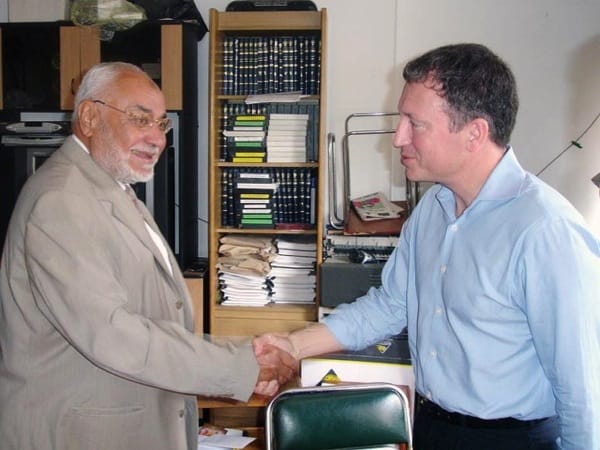
I have a new piece out in Foreign Policy (gift link) arguing against the Trump administration's executive order designating branches of the Muslim Brotherhood as terrorist organizations. It was a strange piece to write, in some ways. I've been engaged in the academic and policy debate about the Muslim Brotherhood for at least twenty years now (the picture illustrating this post is from my meeting with then-Supreme Guide Mohammed Mahdi Akef in Cairo circa 2007) – a debate which had both been thoroughly and decisively settled in its original form, and which had become largely irrelevant in the current era. It's worth going back and reading Nathan Brown's good piece from the last time the issue of designating the MB came up back in 2017, or mine; not much has changed since then.
My new FP article surveys the history and nature of the MB, places the regional push for designation in the context of the specific regime security and ideological concerns of key states such as Egypt, the UAE, Saudi Arabia and Israel, reviews key debates and explains why they have lost relevance, and concludes by arguing that the main driver and impact of the designation now might well be domestic as radical right wing forces use it to accelerate their repression of American Muslim groups like CAIR (as Florida's governor Ron DeSantis just did, following the dubious lead of Texas), student protestors and anti-Israeli political speech, and allegedly left wing foundations and universities.
The MB is complex, conservative, and its practices vary dramatically by national context, but it was never a terrorist organization, and it's been so thoroughly crushed over the last decade by the unbridled repression of autocratic Arab regimes that it no longer even really exists in its classical form. Debates about whether it would moderate through political participation stopped being relevant when Egypt's MB and Ennahda in Tunis won elections and ended up criminalized, repressed, and arrested for their efforts. Debates about whether it would serve as a firewall against violent extremism or a conveyor belt towards radicalism largely ended when the idea of peaceful participation was discredited by violent repression and the organizational capacity which allowed the MB to hold back violent challengers was systematically dismantled by violently repressive "secular" regimes. (I had a long, much-cited article in the Washington Post about this debate a decade ago, and still remember testifying before a 2015 House subcommittee next to Michael Flynn, who was not yet known to be a radical lunatic, arguing for a total war against Islam with no distinction between moderate and radical).
And yet, this being DC, here we are again, having the same old zombie debates promoted by the same old charlatans for mostly the same old reasons.. but this time, in Trump's Washington, with most of the professionals and experts in the government purged and with quaint issues like "truth" or "national interests" or "evidence" now manifestly irrelevant. Non-specialists should understand the move to designate the Muslim Brotherhood as comparable to what Robert F Kennedy Jr is doing to vaccines – a manifestly harmful policy driven by crackpot ideologues using state power to impose their fringe views based on no evidence to win applause from the worst right wing radicals.
For useful background on the MB from a wide range of experts, you can go back and check out the many publications from the long-running POMEPS project on Islamist movements supported by the late lamented Luce Foundation Religion and International Affairs program: Islamists and Local Politics, Adaptation Strategies of Islamist Movements (which includes my frequently cited piece on "the lumpers and the splitters"), Evolving Methodologies for Studying Islamist Movements (with Jillian Schwedler's "Why Islamism Doesn't Help Us Understand the Middle East" and Nathan Brown's review of two generations of Islamism scholarship), Islamism in the ISIS-Age (featuring my overview, Khalil al-Anani's framing essay, Jillian Schwedler on the moderate/radical conceptual confusion), Islamist Social Services, and the launch workshop Rethinking Islamist Politics. Also, if you like, my Carnegie report on Islamists beyond the Egyptian Muslim Brotherhood five years after the uprisings.
Here's how the FP piece starts:
The push to get the United States to designate the Muslim Brotherhood as a terrorist organization is a bad idea with a long history dating back to at least 9/11. It has been repeatedly pushed by right-wing groups in the United States and by anti-Brotherhood allies in the Middle East, including the United Arab Emirates (UAE), Egypt, and Israel. And it has been repeatedly rejected. As former President George W. Bush among others understood, this designation would not only be inaccurate, it would undermine human rights and democracy across the Middle East.
The Trump administration, however, doesn’t care about either truth or democracy and has purged many of the professionals in the civil service who might offer informed analysis. As a result, it is now preparing to take this step at a time when it will be both ever more irrelevant in the region and ever more damaging at home.
In the Middle East, America’s allies have spent more than a decade unleashing the full fury of unrestrained security apparatuses on the Brotherhood (and all other civil society or oppositional forces). As a result, the Muslim Brotherhood has been largely decimated as a popular force, and key regional backers such as Qatar and Turkey no longer care as much to defend it. In America, however, there is every reason to fear that the Trump administration will use the Muslim Brotherhood’s terrorist designation as a tool to target its own political enemies. The result will be to intensify an already dangerous crackdown on migrants, left-leaning civil society, and domestic political opposition.
Read the whole thing at Foreign Policy.