This Must Be The Podcast: Firat Bozçali
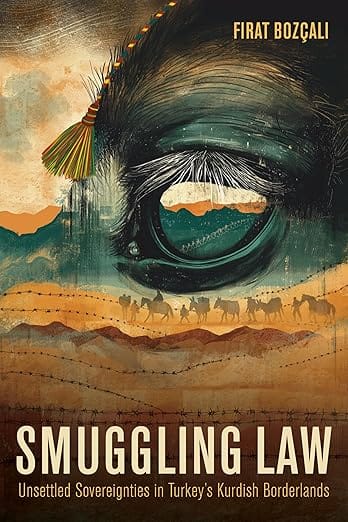
How do states deal with routine cross-border smuggling during periods of protracted counterinsurgency? Firat Bozçali's new book, Smuggling Law: Unsettled Sovereignties in Turkey's Kurdish Borderlands, explores the complex interactions between the state and society in the Kurdish-dominated province of Wan which borders Iran. His careful border ethnography reminded me in some ways of Max Gallien's excellent Smugglers and the State, which traced the informal but highly regulated border traffic across North Africa. But the context is quite different: in Turkey's borderlands, Kurdish smuggling across the border is embedded within a decades-long insurgency and brutal counterinsurgency which puts a hard security lens on otherwise routine networks and transactions.
Bozçali focuses his ethnography not on the border passage itself, but on the courtrooms where lawyers engage in what he calls "sly legality" to challenge the cases against Kurds accused of smuggling. He sets out to show how "Kurdish smugglers and their lawyers repurposed criminal trials to disrupt state authorities' ability to legally exercise sovereign powers over the enforcement of borders." That courtroom lens allows a different way of seeing and understanding the ways that borders, state violence, and the law evolve under conditions of warscape. His interviews and observations reveal the contours of the permissible and impermissible, the routinization of the ostensibly illicit, and the intricate co-evolution of state repressive power and societal practices.
The ethnography also highlights the importance of identity for shaping these encounters. The Kurds in the border province see trade and relations with Kurds in Iran as normal and natural, with militarized border crossings and surveillance obstacles to overcome but not real deterrents. The Turkish state, for its part, recognizes the importance of this smuggling to the local economy and to societal cohesion, and so wants to avoid too much disruption; state agents also take their cut of the action, as is so often the way in these border zones. But its tolerance of illicit trade and the degree and intensity of its surveillance, repression and militarized violence varies with the course of the PKK insurgency and Turkish counterinsurgency – which at various points becomes quite extreme, with drone surveillance, hardened checkpoints, brutal extrajudicial killings, and more. But, as Bozçali demonstrates, life goes on through all this episodic violence – and the courtrooms become a key site of negotiation over the boundaries and modalities of contact between state and smuggler.
I very much enjoyed this book, and was especially delighted to be reminded that we discussed an early version in a POMEPS book workshop a few years ago. Ethnographic work like this is central to the warscape approach I'm developing in my next book, and this is a good one. Bozçali joins me on this week's episode of the Middle East Political Science podcast to talk about Smuggling Law. Listen here:
A Few Good Reads
I am way way behind on my roundups of recent journal articles in Middle East politics. In the meantime, though, I wanted to draw attention to some timely shorter publications by POMEPS friends, which I haven't usually done but fortunately there are actually no rules here. Jonathan Fulton has an extremely useful, well-informed short piece on how the war with Iran is impacting Gulf relations with Asia (and with Iran and Europe). Adam Hanieh has a good piece on the broader economic impact of the closure of the Straits of Hormuz. MERIP has a fantastic roundup of short reflections on the war's impact across the region with contributions from some of the very best scholars in the field including Arang Keshavarzian, Rima Majed, Elham Fakhro, Maryam Alemzadeh, Toby Jones, Melani McAlister, Maya Mikdashi, and many more. Rania Abouzeid has a fantastic piece on Syria since the fall of Assad. Nathan Brown has a number of good pieces up with Carnegie right now, but especially enjoyed this one on the despair of Palestinian youth. Narges Bajoghli has a great Foreign Affairs piece on how Iran prepared for exactly this war, and Mohammed Ayatollahi Tabaar has another on how Iranian leaders view the war.
Upcoming Talks
My last scheduled talk this spring about America's Middle East: The Ruination of a Region will be at Boston University on Thursday, April 2 at 4:00. I'll also be talking about the current war, of course. If you're in the Boston area, this is the only talk I'll be giving there this spring so try to come – it's hosted by the Pardee School of Global Studies, 4:00 on April 2 at 121 Bay State Road. And in the meantime, please buy the book and consider using it in your fall classes, if teaching is the sort of thing you do. You won't regret it.