This Must Be the Podcast: Stephane Lacroix
I'm on the road this week for the Ruination Tour. Please come out and see me, if you can, at one of these stops: Princeton University, today (Tuesday) at 4:30 at the Bobst Center; Wednesday, New York City - in conversation with Jillian Schwedler at Hunter College's Roosevelt House, 47 E 65th, at 1:00; and Thursday, Yale University, in conversation with Rob Malley at 12:00, in the Council on Middle East Studies Colloquium in Luce Hall. I'm looking forward to this series of talks and conversations about my book America's Middle East: The Ruination of a Region... and about what Trump's latest moves mean for it all.
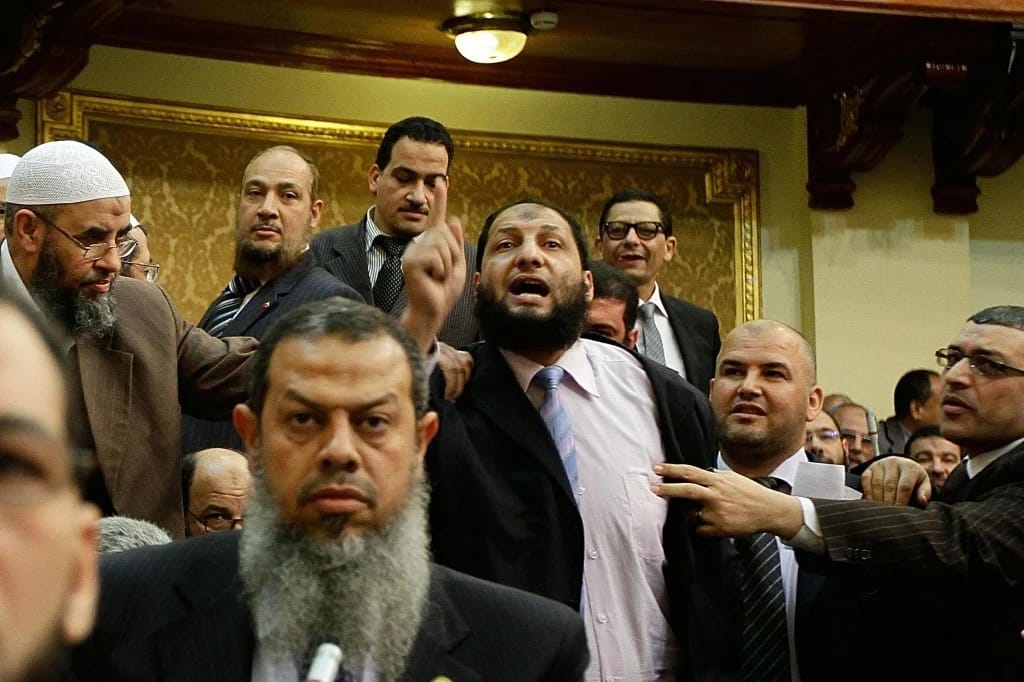
Stephane Lacroix's Twilight of the Saints represents the best available sociological and political science account of the Egyptian salafi movement from the 1920s through the 2011 Egyptian revolution and the brutal military coup which followed. Lacroix joins me on the Middle East Political Science podcast this week to talk about his terrific book, which I'm proud to have published in my Columbia series.
To a lot of observers, Egyptian and outside, the salafis seemed like the proverbial slippery people after Hizb al-Nour suddenly decided to contest Parliamentary elections in 2011 after long rejecting democratic participation and then seemingly reversed course to support Sisi's military coup in 2013. They often lumped al-Nour in with the populist Salafi firebrand presidential candidate Hazem Abu Ismail, who ran strong in the early days of the presidential election before being disqualified on trumped up grounds like other candidates deemed problematic by the Egyptian state (including the Muslim Brotherhood's Khairat el-Shater, who probably would have been a more effective president than Mohammed el-Morsi.... one wonders if Shater, with his political savvy and economic focus, might have followed Ahmed al-Sharaa's trajectory and made a much better Egypt than the one made by Sisi's military coup, but that's a question for another day).
Lacroix's focus is not the Brotherhood, but the Salafi movements which competed with the Brotherhood intellectually, culturally, and eventually electorally. Lacroix argues convincingly that the decision by the al-Nour Party to contest the 2011 Parliamentary elections did not actually come out of nowhere, and did not actually represent a shift from an apolitical stance. Salafis had been developing forms of political praxis for decades, rooted in intellectual production and social transformation. Lacroix shows how from the start Salafis focused on producing books and reshaping Islam in the public sphere. Avoiding the kind of electoral participation or mass mobilization which the Brotherhood mastered never meant that they shunned politics. Lacroix offers a fascinating interpretation of their political theory in which redefining the contours of Islam and the public sphere is a form of political praxis – and, in his astute telling, an enormously successful one which has fundamentally reshaped the basic language and cultural assumptions surrounding Islam.
Lacroix then shows how the Brotherhood, decimated by Nasser-era repression, rebuilt its ranks after emerging from prison in the 1970s by absorbing salafi student movements (which produced many of the most influential and well-known Brotherhood political leaders in later years), which reshaped both the Brotherhood and the salafi trends which did not join up. Along the way, he notes that the influence of Sayyid Qutb tends to be exaggerated in those circles, and the influence of Mawdudi underestimated. He then shows how institutionally different, often competitive, strands of the salafi movement responded differently to the incentives and opportunities opened by the 2011 revolution and the 2013 coup.
Lacroix also offers a finely grained and savvy take on the Egyptianization of the Egyptian salafi movement. He is skeptical of the popular idea that the Egyptian salafis are Saudi proxies, a stance given particular credibility given his background in Saudi Arabia (I consider his 2011 Awakening Islam, on the Saudi Sahwa movement, one of the best books about the Middle East of that decade). He does not dismiss the importance of Saudi Arabia, particularly in the early years, and documents the transnational circulation of ideas, individual scholars and activists, and remittances from Egyptians working in the Gulf which financed salafi mosques and intellectual production. But Egyptian salafis matured over time, and eventually had little interest in taking religious or political guidance from abroad (especially after the major figures of Saudi Wahhabism passed from the scene).
Listen here to my podcast conversation with Stephane Lacroix:
Egyptian salafism has been somewhat neglected relative to the Muslim Brotherhood and jihadist movements, but that's begun to change in recent years. Many of the books discussed below have been discussed either on this blog or on my podcast, to which I've linked where appropriate.
POMEPS Studies 2 The New Salafi Politics was one of the very first issues in the POMEPS Studies series, featuring a wide range of authors assessing the electoral and political role of the salafis in the wake of the uprisings. A more fully developed and authoritative volume edited by Francesco Cavatorta and Fabio Merone, Salafism after the Arab Uprising, similarly brings together a wide range of experts to address cases across the region. Azmi Bishara's On Salafism offers a brief and accessible introduction.
There are a handful of academic books that look directly at Egyptian salafis which nicely complement Twilight of the Saints. Lacroix highlights the ways in which salafis came to dominate the book publishing sphere in Egypt, and then later pioneered the circulation of cheap booklets, cassette sermons, and television programs. Aaron Rock-Singer's Practicing Islam in Egypt delves deeply into the history of salafi print publications. Yasmin Moll's The Revolution Within examines salafi television broadcasting before and especially after the Egyptian revolution, while Charles Hirshkind's brilliant The Ethical Soundscape remains an authoritative account of their use of cassette tape sermons to circulate their religious ideas and to transform the aural soundscape of the city.
Lacroix appropriately puts a lot of emphasis on how Egypt's salafi movement evolved within a broader religious and political field (in the Bourdieuian sense). The Muslim Brotherhood loomed largest in that competition over religious authority. Several major recent books have explored the interactions and competition between the Brotherhood and salafis in Egypt. Hesham Sallam's Classless Politics and Abdullah al-Arian's Answering the Call both focus in on the pivotal decade of the 1970s, as the Brothers emerged from prison and took stock of the emergent salafi dominated Islamic student movements. Both show how the Brotherhood engaged with and often absorbed parts of those salafi youth movements. Sumita Pahwa's Politics as Worship digs deeply into the public debates and discourses among Brothers and salafis in Egypt's politics across the 1980s and 1990s, and shows how those polemics shaped the responses to the 2011 revolution. Several other important books flesh out the dynamic interaction of the Brotherhood and salafists across the realms of organizations, ideology, and political practice: Khalil al-Anani's Inside the Muslim Brotherhood; Joas Wagemakers's The Muslim Brotherhood; Carrie Wickham's The Muslim Brotherhood; Victor Willi's The Fourth Ordeal; and Nathan Brown's When Victory is Not an Option. Finally, Khalid Medani's Black Markets and Militants isn't about the salafi movement per se, but it does put a very concrete imprint on the often abstract discussions of Saudi support for salafism by tracing the rise of Islamic banking and remittance flows from the Gulf into Egypt (as well as Sudan and Somalia).
Rock-Singer's In the Shade of the Sunna, the book which is perhaps the most similar to Twilight of the Saints, goes deep into the doctrinal debates and discourse within the movement. Henri Lauziere's The Making of Salafism puts the rise of the movement in Egypt into broader perspective. Joas Wagemakers's Salafism in Jordan offers a useful discussion of the contemporaneous emergence and evolution of the movement in a different context.
This emergent research on the interactions among and differences between different Islamic trends in Egypt and across the Muslim world represents a tremendously healthy development. It takes Islamists seriously on their own terms while rigorously analyzing them within comparative theoretical frameworks that avoid exoticizing them or exaggerating their differences from a supposedly secular or rational "us" (which used to be more of a thing back before, well, look around).