This Must Be The Podcast: Steven Monroe
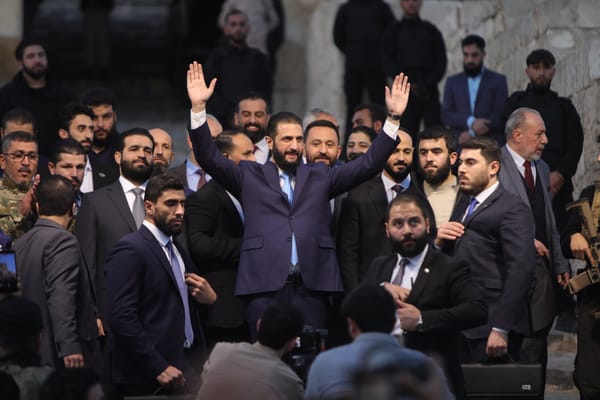
The twists and turns in the rapidly evolving Middle Eastern order continue to unfold. Syria's SDF suddenly collapsed across much of its territory and signed a ceasefire with the Syrian government, potentially heralding an important advance in the consolidation of a centralized state – but one that is not yet a done deal, as mobilization in Kurdish-dominated areas accelerates and some leaders cast doubt on the ceasefire. Iran's protests have largely faded under fierce repression, but Israel and the US are still evidently contemplating military action. The Trump administration is pushing forward an increasingly farcical "Board of Peace" not just for Gaza but for the world; thus far, Morocco and the UAE are the only Middle Eastern states to join.
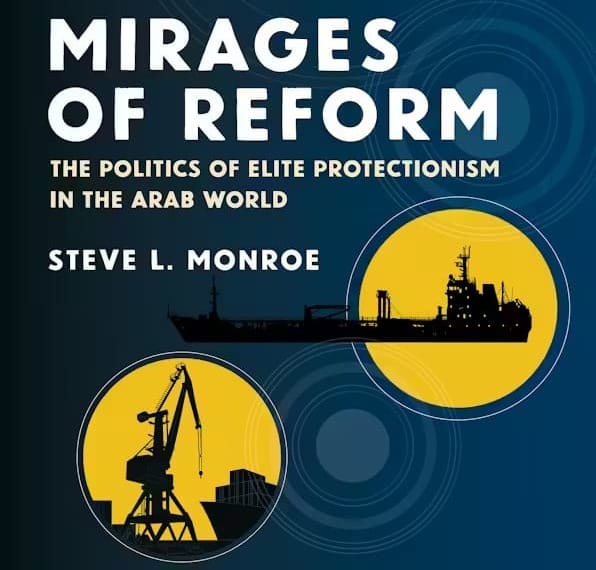
I will have things to say about such things soon. But even when we have to grapple with life during wartime, the MENA Academy continues to produce great scholarship. And so, same as it ever was, This Must Be The Podcast. This week's episode of the Middle East Political Science Podcast features Steve Monroe's Mirages of Reform: The Politics of Elite Protectionism in the Arab World (Cornell University Press, 2025).
Monroe uses the case of Jordan to discuss the broader failures of economic reform across the Middle East, which might not be exactly failures if you consider the underlying regime logic in adopting them (a point that Steven Heydemann and I make at length in our introduction to Making Sense of the Arab State). Monroe develops a theoretical framework focused on the ability of connected elites to shield themselves from the effects of reforms enacted on paper. On this week's episode, we talk with Monroe about his book and its broader implications. Listen here:
It's great to have a book focused on political economy in our mix. There's a lot of critical literature worth looking at. On the failures of economic reform, Peter Moore's Doing Business in the Middle East is in many ways the most direct ancestor of Mirages of Reform. Other foundational texts here include Melani Cammett's Globalization and Business Politics in the Middle East, Clement Henry and Robert Springborg's Globalization and the Politics of Development in the Middle East, and the authoritative textbook authored by Cammett and Ishac Diwan (taking over from Alan Roberts and John Waterbury for the fourth edition), A Political Economy of the Middle East. The recent volume A Critical Political Economy of the Middle East, edited by Joel Beinin, Bassam Haddad, and Sherine Seikaly, offers a useful contrapuntal reading.
I'm a big fan of Adam Hanieh's Money, Markets and Monarchies, which gives granular detail on these emergent political economies and their inclusions and exclusions. Amr Adly's Cleft Capitalism traces similar dynamics in Egypt, while Steffen Hertog's Locked Out of Development: Insiders and Outsiders in Arab Capitalism, Robert Kubinek's Making Democracy Safe for Business, and Ferdinand Eibl's Social Dictatorships expand the scope to multiple countries. Eva Bellin traced similar political economy obstacles to democratization in Tunisia in Stalled Democracy. We discussed many of the issues related to the insider/outsider divide in POMEPS Studies 33 The Politics of Rentier States in the Gulf – see my introduction co-authored with Michael Herb.
Monroe's primary case study is Jordan. There's been a lot of great research on every aspect of Jordanian politics, but let me recommend a few that I especially like. Sean Yom's just-published Jordan: Politics in an Accidental Crucible will be featured on an upcoming episode of the podcast, and is going to quickly and deservedly become a standard text in the field. A bit older, but still essential, check out Curtis Ryan's Jordan and the Arab Uprisings and Jillian Schwedler's Protesting Jordan. Scott Williamson's The King Can Do No Wrong, featured on the podcast last year, offers a novel take on the functioning of the monarchy in the Jordanian political system. On Jordanian/Palestinian identity politics, my very old book State Interests and Public Sphere: The International Politics of Jordan's Identity still offers what I think is a fresh take on the role of the media and public discourse in shaping identity politics. About a decade ago, Mohammed Torki Bani Salameh andKhalid Issa El-Edwan had a fascinating article in Nationalities Papers on the efforts to form a Jordanian national identity. That will do for now – I'll have a more thorough overview of scholarship on Jordan in a couple of weeks when we discuss Yom's book.
Over the weekend, I talked about the Saudi-UAE rift with NPR's All Things Considered. I had a terrible cold, but hopefully it came out okay. Listen here:
If you're in the Columbus area, come by Ohio State's Mershon Center tomorrow at noon for lunch and my talk about America's Middle East: The Ruination of a Region. I'm very grateful to Mershon for hosting me as a visiting scholar for several years, and excited to return to the community to share my work. See you there, Buckeyes!