What if it works?
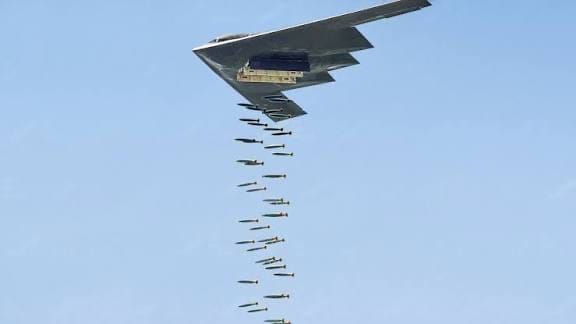
The Trump administration has been steadily assembling a vast armada of airpower in the Gulf, ostensibly to apply pressure on Iran during negotiations. While the administration has been urging Iranian leaders to take a deal, American public demands on Iran on nuclear enrichment, ballistic missiles, and regional allies seem like a nonstarter based on past Iranian positions. Perhaps the military buildup is simply meant to strengthen Washington's hand in the negotiations, perhaps the negotiations are simply a smokescreen to once again entice Tehran to lower its guard ahead of a surprise attack.
The move towards a large-scale war with Iran is happening with virtually no public debate. Congress has paid virtually no attention. The media barely covers it. Even the foreign policy community commentary is a desultory affair, which tends to treat an American attack as a fait accompli. That's remarkable. Decades of intensely heated debate has consistently produced a broad consensus that bombing Iran would be exceptionally risky, unlikely to produce either regime change or a lasting end to its nuclear program while inviting catastrophic Iranian retaliation or an equally devastating state collapse destabilizing the entire region. That debate has rarely been engaged in the rapid runup to war. To the extent that there has been any policy debate at all it has been a caricatured one in which either an attack will be a cakewalk or a catastrophe.
The Trump administration has not deigned to explain its objectives, its strategy, or its legal justification for bombing Iran. One suspects that acting in defiance of international law, expert opinion, and the role of Congress is its own reward for this team. Whether through a deal or war, Trump's goal seems to be to decisively end the decades long American struggle with Iran one way or the other. But decisive victories are for children and pundits. Every "decisive victory" in the Middle East soon dissolves into something messy, chaotic, and unexpected, setting the stage for the next round of conflict rather than ending it - Bush's "mission accomplished" in Iraq, Israel's decapitation of Hezbollah or destruction of Gaza, Russia's defense of Bashar al-Asad in 2015, you name it.
It is traditional for skeptics of bombing Iran to assume that it will fail catastrophically. So, playing against form, I ask: what if it works? To be clear, by "works" I mean something like the Israeli decapitation of Hezbollah: the bombing campaign kills the senior leadership of the Islamic Republic and seriously degrades state repressive capacity (which, of course, did not actually end Israel's ongoing attacks on Lebanon or deliver Lebanon to a post-Hezbollah future but did quite decisively shift the balance of power for a while). That's more than most skeptics expect and would be close to a best-case outcome for Trump. What would that best case actually look like?
My new article in Foreign Policy starts from the assumption that an American attack, if it happens, would be limited to a strategic bombing campaign combined with ongoing destabilization efforts. Trump has a manifest preference for one-off decapitation strikes and sensational displays. Avoiding another Iraq-style occupation, which he has often described as one of America's stupidest foreign policy decisions, is one of the very few policies to which Trump has consistently adhered for decades. The US has been surging aircraft carriers and support equipment to the Gulf, not expeditionary ground forces for an invasion, and there has been no public evidence of any planning whatsoever for an American presence in Iran. As with the kidnapping of Venezualan president or the killing of IRGC commander Qassem Soleimani, or Israel's decapitation strike against Hezbollah's Hassan Nasrallah, a US attack on Iran will likely directly target top leadership and the regime's repressive apparatus and then let the cards fall where they may.
So where will the cards fall?
The FP article lays out five scenarios for what might follow from an American aspirational regime-change bombing campaign. The first argues that a bombing campaign that doesn't topple the regime will just be another reset of the status quo, killing many Iranians and causing vast destruction without changing much in either Iran's domestic or regional policies. The regime is dug in, expecting an attack, and has long thrived in chaotic conflict environments. Should the Islamic Republic be toppled, there are four potential trajectores: A democratic republic is unlikely to emerge from that kind of devastation no matter how much Iranians want it and deserve it, and a restoration of the Shah is unlikely without external military forces on the ground (hard to ride in on the back of a tank if there are no tanks). That leaves a choice between a failed state and civil war on the one hand, or the reconsolidation of power by the strongest force on the ground - the IRGC.
As is increasingly the case in regional politics, there's real disagreement between Israel and most Arab regimes about which of these outcomes would be preferable. In the FP article, I argue:
Israel may well be just fine with a divided, weak, and fragmented Iran consumed by civil war and ethnic splintering. But the United States does not seem to share that aspiration. Its embrace of Ahmed al-Sharaa’s regime in Syria (and its cynical elevation of Maduro’s vice president in Venezuela) suggests that it prefers stability under whatever regime is available. Above all, the Gulf states want to avoid another destabilization in the Middle East at all costs, with all the refugees, terrorism, and instability that it would entail. Their top priority at this point is to avoid a collapsed Iran dragging the rest of the region down into the hellmouth, destabilizing Iraq and Syria, as well as potentially disrupting oil shipping.
To be clear: I don't think we should bomb Iran and I would also like to not see the region dragged further down into the hellmouth. I do think that we owe America, Iran, and the world a much more serious debate before taking such a step. After the video content for the administration's social media feeds has been posted and victory declared, Trump will move on to the next thing. But the Iranian people and the Middle East as a whole will be living with the carnage for years to come. Read the whole article here at Foreign Policy (gift link).
What if it Works? , the title of this post, was one of the last great songs released by the Loud Family before the tragic death of the great Scott Miller.