What Middle East academics thought about war with Iran
That and more in the new wave of the Middle East Scholars Barometer
I'm pleased to be able to share the results of the recently completed ninth wave of the Middle East Scholars Barometer. Shibley Telhami and I have been polling scholars of the Middle East once or twice a year since 2021, including members of the American Political Science Association, the American Historical Association, the Middle East Studies Association, and those affiliated with the Project on Middle East Political Science. This year, we had 641 respondents, with roughly three-quarters of them based in the United States.
This year, along with questions about the Israel-Palestinian conflict, Gaza, Syria, and the campus climate, we asked a batter of questions about Iran. The survey period of Feb. 19 to March 11 spanned the launch of the war, with about one-third of the responses coming after it began, allowing an unusual opportunity to assess changes in views after the fighting got underway. Telhami and I have an article up in Foreign Policy today sharing and analyzing the results of the Iran parts of the survey. Overall, we found overwhelming opposition to the war, deep skepticism that it would produce either democracy or a pro-American autocracy, and a really concerning upsurge in self-censorship around issues related to Iran which is not yet at the level we see around Israel and Palestine but is trending in that direction.
Here's how the Foreign Policy article (paywall free link) starts:
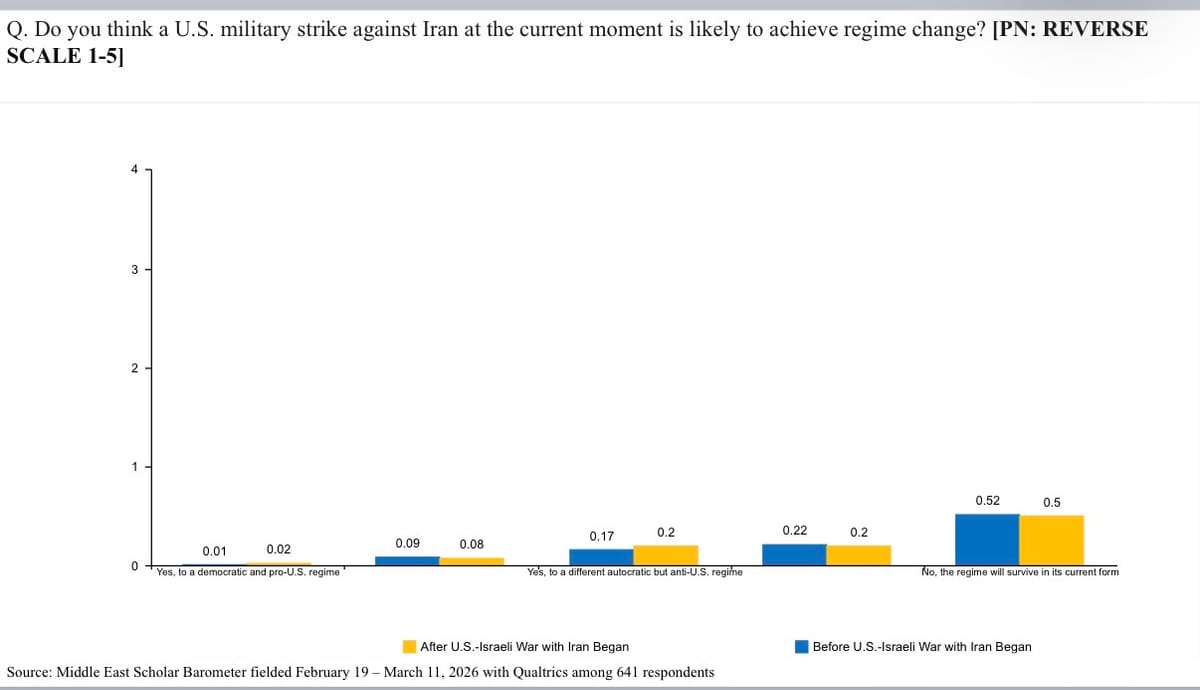
Many Americans opposed going to war against Iran, including some Republican voters, but among academics who study the Middle East, the opposition was overwhelming. Only 5 percent of academic experts polled in the days leading up to the Feb. 28 U.S.-Israeli attacks supported launching a war and only 1 percent thought that a broad assault would produce a pro-American democratic regime in Iran. Some 94 percent of experts thought the Trump administration’s approach to Iran was making such a war more likely—an overwhelming consensus. Expert knowledge is often dismissed by this administration but in retrospect it seems that academics understood better than policymakers the cohesion of Iran’s regime and its ability and willingness to fight back.
Most academic experts on the Middle East know a thing or two about democratic transitions, the resilience of autocracy, and the devastation caused by these wars. Their views of the region are shaped both their research and their teaching, language skills and local knowledge, and by deep personal connections – all of which contrasts sharply with the Trump administration, especially after the politicized mass purging of so many of the experienced, skilled and knowledgeable civil servants in the State Department and intelligence agencies. Their collective skepticism about the likely effects of the war on Iran – both before and after it began – is really striking:
The experts had little patience with the expectations widely circulating in the media about the imminent fall of the Iranian regime. Almost no respondents expected the war to result in a pro-American regime of any kind, and 9 percent expected a pro-American autocratic regime to take over, such as through a Venezuela-style replacement of Iranian leader Ayatollah Ali Khamenei with a more pliable and friendly dictator. That reflects the hard-earned wisdom of scholars who have seen the failure and the human devastation of many U.S. efforts to impose regime change from afar.
Instead, a solid 51 percent expected the Iranian regime to survive in something like its prewar form—an outcome that is looking increasingly likely and that the scholars anticipated far better than the pundits or the Israeli and U.S. officials briefing them. And, of course, many scholars saw that things could get worse: 18 percent expected the emergence of a new anti-American autocracy, such as an Islamic Revolutionary Guard Corps-led military regime, and 21 percent expected state failure and civil war. Strikingly, none of those percentages changed much among those who responded before and after the war began, despite the intensity and devastation wreaked by the United States and Israel, and the killing of so many regime officials.
There's a lot more in the article about various aspects of the war, but I especially want to draw attention to the remarkable increase in academic self-censorship around Iran, which jumped from 20% of respondents before the war started to a shocking 40% after it began.
It is not immediately obvious why, but we can suggest a few possibilities. Since this war involves not only the United States and Iran but also Israel, it could be that many who worry about criticizing Israel on its policies toward Palestinians (the majority of scholars polled) now also have to factor in criticism of Israel over the Iran war. Concerns that identifying Israel as responsible for pushing Trump into a catastrophic war might accelerate antisemitism could be inhibiting some people. It could also be concerns about criticizing the U.S. government at wartime. And in some contexts, it could be the new laws imposed in several states that bar classroom discussion of “divisive topics.”
But the most likely explanation, in our view, is the remarkable degree of vitriolic, intense attacks launched by the pro-Shah/anti-regime Iranian diaspora against anyone they deem insufficiently critical of the Islamic Republic. For years, Iranian journalists and academics have faced online abuse and professional pressure comparable to the experience of those who speak out on Israeli-Palestinian issues. Those attacks have ramped up over the last few months, with widespread instances of panels being disrupted by protesters. Numerous Iranian academics report being targeted on social media and reported to their deans and boards of trustees, often with pressure for them to be fired or removed from leadership positions. The shift toward self-censorship as the war unfolded could be an alarming canary in the coal mine for the ability of scholars to freely share their expertise on yet another critical foreign-policy issue.
I've been hearing a lot about these sorts of pressure campaigns, usually against Iranian academics, over the last few months. I've heard about pressures to get people fired from their leadership positions or even stripped of tenure. I've heard about a lot of public events disrupted by pro-Pahlavi protestors. And I've seen the usual toxic waste sloshing around social media. It's not totally new, of course, but it does seem to have reached a new level of toxicity. And that's the last thing Middle East academia needs right now.
The Barometer covers a lot of issues besides Iran of course. We asked a number of questions about the impact of AI on Middle East Studies teaching and research for the first time. One of the more distressing results is that 51% of respondents in the US said that students were more likely to self-censor in classroom discussions related to Israel and Palestine than before October 7 – a clear trickle down effect of the intense polarization and brutal institutional crackdowns the last two years. Only 1% of respondents think the adoptoin of the IHRA definition of antisemitism would have positive impact on their research (63% thought it would be negative, while a remarkable 85% said they personally disagreed with it. 54% of respondents now describe Israel's actions in Gaza as genocide, and another 32% as major war crimes akin to genocide. 70% now describe the current reality in Israel, the West Bank and Gaza as "one state reality akin to apartheid." 92% said they did not expect Trump's Board of Peace to establish an effective government in Gaza without Hamas, and 82% expect Israel to annex some or all of Gaza. So everything is going great.
There's a lot more to chew on in the survey results. Read the whole FP article here, and see the whole MESB questionnaire and results here.