Why the Middle East should mourn Habermas
Apologies for a second mailing in one day, but this one has been eating at me for the last week and rather than try and publish it somewhere I decided to post it here.
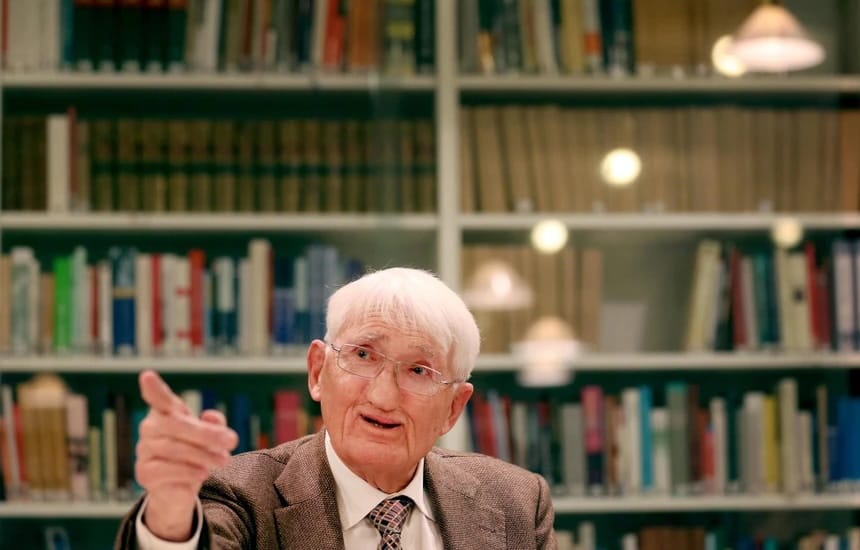
The German philosopher and social theorist Jürgen Habermas passed away over the weekend at the tender age of 96. At least he outlived the public sphere and the rational forms of modernity that had been his life's work. In certain circles in Middle East politics, Habermas's legacy will always be defined by his role in a letter from German intellectuals defending Israel against allegations of genocide in Gaza shortly after October 7. While that letter was poorly considered, and in many ways a betrayal of his own philosophical and theoretical precepts, it should not allow his legacy to be dismissed so easily by those who work on and care about the Middle East. Habermas gave us essential and unique tools for understanding our current predicament and pointed the way towards the forms of critique which might have offered – and might still offer – a better alternative.
There are many other others who can review Habermas's career, his social theory, his many works, and the finer points of his philosophy. I’m just a humble Middle East politics scholar. I'm happy to admit that his prose was often turgid and plodding, and many of the directions his thought developed uninteresting to me, and I wouldn't advise any casual reader to rush out and pick up one of his multi-volume works on social theory. But for all that, Habermas was absolutely central to my academic and intellectual evolution. His historical sociology of the public sphere shaped my approach to the Arab media, while his distinction between communicative and strategic action lies at the heart of my foreign policy critiques. (For the record, I relied heavily on Structural Transformation of the Public Sphere, The Logic of Communicative Action, and Between Facts and Norms, and almost as much on the brilliant critiques and glosses by scholars such as James Bohmann, Craig Calhoun, Nancy Fraser, Michael Warner – sorry to everyone I forgot, it's been decades.)
I was always most interested in the critical potential and the empirical application of Habermas's ideas. One of my first major published articles was about the “dialogue of civilizations" proposed by then-Iranian President Mohammad Khatemi as an alternative to the “clash of civilizations" then being popularized by figures such as Samuel Huntington and Bernard Lewis. Khatemi, who like many Iranian politicians was well-versed in Habermas and other European political theory, proposed a new approach to dialogue as a way to resolve entrenched conflict between not just Iran and America, but between Islam and the West. His ideas would ultimately be taken up by the United Nations, which declared 2001 the year of the dialogue of civilizations. That initiative came crashing down through the combination of Osama bin Laden, who preferred clashing civilizations to dialogues among them, and the hardliners in the United States and in Iran who shared a preference for conflict over dialogue. In subsequent years, Khatemi and his allies lost power inside Iran as hardliners crushed the reform movement, while the Bush administration lit the Middle East on fire with its global war on terror and invasion of Iraq. It is still important to remember that other pathways were conceivable, if not in the moment possible.
I published a broader article on the role of dialogue and communicative action after 9/11, discussing the possibility of "dialogue in an age of terror" which again drew on Habermas to seek pathways out of the post-2001 abyss). That got me into a lot of arguments with the emergent cohort of pundits and scholars, some of them formerly on the Left, who had thrown themselves wholeheartedly into the campaign to demonize Islam as a religion – which has left us with so many toxic legacies across Western democracies to this day. I should note that Habermas himself entered into the public and scholarly debates about religion and rationality in later years, in ways I never found particularly helpful or interesting, so I didn't pick up that thread.
I also drew on Habermas's distinction between communicative and strategic action to critique coercive diplomacy, using the US and China as a case study for the value of engagement. The logic of that argument (which engaged with what was then an active stream in constructivist IR theory - remember the "logic of appropriateness" and all that?) applied much more broadly to international relations. His concept of an ideal speech situation in which only the force of the better argument among all individuals affected by a choice is perhaps the best and most potent articulation of liberalism that I have ever found. Of course, such an ideal speech situation is rarely approximated in any form of politics anywhere, and certainly not in international realtions, but it didn’t have to be actualized in order to serve as a basis for critique of actually existing politics. In particular, I think it helps to explain a great deal of the successes and failures of US foreign policy in the Middle East. Consistently, the US treats actors in the Middle East as problems to be overcome or assets to be manipulated, rather than as fully equal partners, human beings even, with their own interests, identities, and goals. And that is why its strategic successes so often come at tremendous human cost, and why it has so consistently and overwhelmingly failed to build any real political support or normative consent for the regional order it dominates (an argument I presented in my first Foreign Affairs article, way back in 2003).
The most influential part of Habermas for me, though, was of course his discussion of the public sphere, its relationship to democracy, and its rise and fall in the face of capitalism and the state. Voices of the New Arab Public was my effort to use Habermas to understand the emergence of new Arab media forms such as satellite television and the internet in the 1990s and 2000s. In the Arab world, the absence of a meaningful public sphere at the domestic level in the 1970s and 1980s was central to the resilience of authoritarianism and the emptiness of formal democratic institutions. Habermas showed how genuine liberal democracy demands required a public sphere. But he was no cheerleader for the actually existing public sphere. He chronicled the rise and fall of the public sphere as central to the crisis of democracy, as an early genuine public sphere became corrupted by the combination of capital and state power. His advocacy for liberal democracy involved recapturing that public sphere from those twin forces of oppression.
My account of the Arab public sphere closely followed that arc, with obvious contextual and historical differences. But I argued that the emergence in the 1990s and 2000s of a transnational Arab public sphere rooted in satellite television, the blogosphere and other forms of social media, and an outpouring of new online/print publications was breaking the state monopoly over public discourse on which the autocracies of the day depended. I argued that we could see a critical rationality emerging in this Arab public sphere which, for all its flaws, encouraged intense public debate and critical discussion of shared concerns such as Palestine and Iraq, domestic corruption, failed governance, autocracy, and stagnation. The transnational nature of this Arab public sphere allowed it to circumvent state power and censorship, for a while, but ultimately worked against it when it came to translating those ideas into outcomes – exactly the problem Habermas identified very clearly in his later work on the challenges to democracy.
I then traced the ways in which state and capital pushed back to re-colonize the public sphere and strip away its democratizing potential. Over the course of the 2010s, states moved aggressively to repress, co-opt, and manipulate the core platforms of the Arab public sphere. States launched their own satellite television stations to compete with al-Jazeera, while al-Jazeera itself succumbed to the political control of its Qatari funders. The internet couldn't be suppressed, really, but it could be politically neutered by flooding social media sites with regime supporters, attacking critics, and generally polluting the information space in ways meant to defend its power where possible and harness it to their own interests when possible. Twitter and Facebook degenerated into drivers of polarization, disinformation, and conflict. Capital also played a role here as well, as Saudi Arabia and the UAE became major investors in Twitter and central players in the AI boom. The colonization of the public sphere by state and capital in the Arab world wasn't exactly the same as in Habermas's European modernity, but it rhymed.
Why should people still angry about the Gaza letter care about all of this? Because I still believe that Habermas gives one of the strongest foundations for defending the rights of Palestinians and Iranians and Lebanese – and Israelis, and everyone – to not be subjected to wonton massacre, starvation, and abuse. Their recognition as fully equal human beings whose interests and lives must be taken into account for any action or outcome to be just is the essential starting point for an accounting of our grim era. When Israel launches its war in Gaza or on Lebanon, it does not see Palestinians or Lebanese as fully equal human beings, whose lives, ideas, and identities have equal value to their own. They are objects to be manipulated, destroyed, or overcome or in other cases, useful tools to advance self interest, but not autonomous individuals whose aspirations and rights inherently whole value under themselves. This is precisely the logic of strategic action instead of the logic of communicative action.
Habermas rejected the self/other divisions and tribalist identity politics, so beloved of other, edgier social theorists. He did not see politics as a form of warfare between competing identities, and he did not see truth as defined by power. Perhaps he was naïve, perhaps he failed to live up to his own lofty standards. But to me, his social theory remains an indispensible foundation for liberalism and aspirational rationality. The public sphere has been so thoroughly colonized by state and capital, so thoroughly polluted by polarized politics and toxic algorithms, that it becomes harder and harder to even imagine one which is not. That leaves little room for empathy or mutual understanding. But it is precisely the death of those aspirations and the absence of their functioning, which makes us understand deeply why Habermas and his idealized public sphere will be missed.