Gause, the State, and War
I'm in that rare situation of publishing two pieces at the same time which, in key ways, disagree with each other: my contribution to a Middle East Law and Governance roundtable celebrating the scholarship of Gregory Gause and a short piece for the Arab Center in Washington based on remarks I made at their annual conference last week. The tension between the two pieces is indicative of the dramatic and incalculable impact of the US-Israeli war on Iran, which in my view has radically shifted the terms of the debate about the importance of capable states and regional order.
The MELG roundtable, organized and introduced by Bassel Salloukh, invited a range of (mostly) Middle East International Relations scholars to critically engage with some aspect of Gause's scholarship over the course of his career: Fred Lawson on revolutionary contagion, Morten Valbjørn on sectarianism, Curtis Ryan on underbalancing and alliances, May Darwich on threat perceptions and regime security, Lisa Anderson on monarchies, Jillian Schwedler on whether Middle East Studies really missed the Arab uprisings.
My contribution took on his 2022 Foreign Affairs article, "The Price of Order", which had argued against a return to democracy promotion and grand schemes for regional transformation. Written at a time when it still seemed like the Biden administration might be serious about turning Mohammed bin Salman into a pariah over the murder of Jamal Khashoggi and the war in Yemen, "The Price of Order" argued that US policy should first deal with the real problem of the Middle East:
"The weakness, and in some cases collapse, of central authority in so many of the region's states is the real source of its current disorder. The civil wars in Libya, Syria, and Yemen, along with the frail governments in Iraq, Lebanon, and the quasi state of Palestine, define the long-term geopolitical challenge of the region. These political vacuums invite the intervention of powers near and far. They allow sectarian and ethnic identities to become more salient. They give terrorist groups opportunities for growth. They impede economic development. And they create profound human suffering, which leads to massive refugee flows. Rebuilding central government authority is the necessary first step for the region to escape its current Hobbesian nightmare."
I agreed with almost all of that – but disagreed with his proposed solution: “the hard reality…that dealing with extremely flawed regimes, with blood on their hands, is sometimes the only way to check the dangers of disorder.” That, I argued, was not a radical course correction from the follies of democracy promotion - it simply described the actual practice of US diplomacy for virtually the entire history of America's long decades of primacy in the Middle East: "The United States has never prioritized democracy or human rights in the Middle East, whatever its rhetoric, and has always preferred to have friendly autocrats take care of hostile public opinion on its behalf." Working with and through those regimes had not, in fact, produced order – far from it. Those regimes, obsssed with their own survival and contemptuous of niceties like human rights, democracy, and good governance, had consistently produced and reproduced precisely the problems that Gause would like to solve:
"State weakness is indeed a major problem shaping regional disorder. Strengthening central states might make for a more orderly region if they were actually states headed by regimes that prioritized development, security, and democracy. But they are not. The central problem of order in the region is caused by regimes buttressed by strong states, not solved by them. Strengthening those states under these conditions would be the equivalent of handing more gas and matches to a convicted arsonist, while earnestly pretending that it is a firehose."
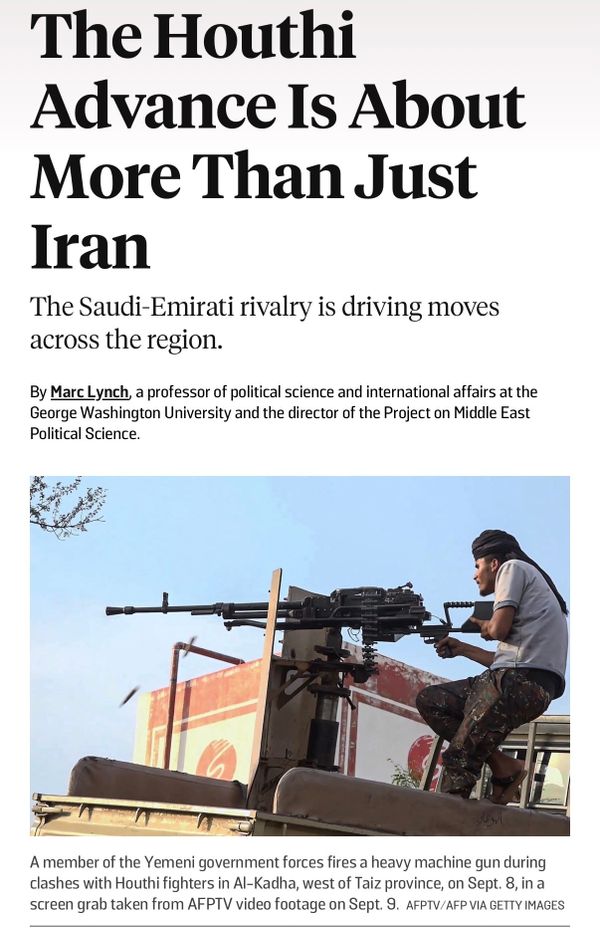
Gause and I have been having variations of this debate for years, and each of us no doubt believes that we've had the better of the argument. It was fascinating to see the Saudis adopt much of his line of argument late last year when they broke with the UAE, accusing it of promoting secessionist movements and calling instead for strengthening states to preserve regional order (I would not associate myself with the UAE side of that argument, obviously – I would prefer to see competent and capable non-autocratic states that respect human rights and are responsive to public opinion, if anyone cared).
But right now, seven weeks after the launch of the absolutely disastrous and demented US-Israeli war on Iran, the whole debate plays out differently. In my piece for the Arab Center, I step back from the strategic issues and politics of the US-Israeli war on Iran to urge a constant focus on "the sheer scope and scale of the catastrophe that has been inflicted upon the people of Gaza, Iran, and Lebanon, and to a lesser extent Israel and the Gulf states. The magnitude of displacement, death, and immiseration will reverberate for years, intensified by the degradation of state capacity across the region to manage or mitigate the aftermath." I have little patience for pundits declaring Iran the "winner" of the war, or a new "fourth world great power", when its infrastructure, economy, people and state have suffered such grievous and gratuitous destruction. That doesn't mean the US and Israel have won, or course - there are no winners here, and the collective losses are only going to escalate.
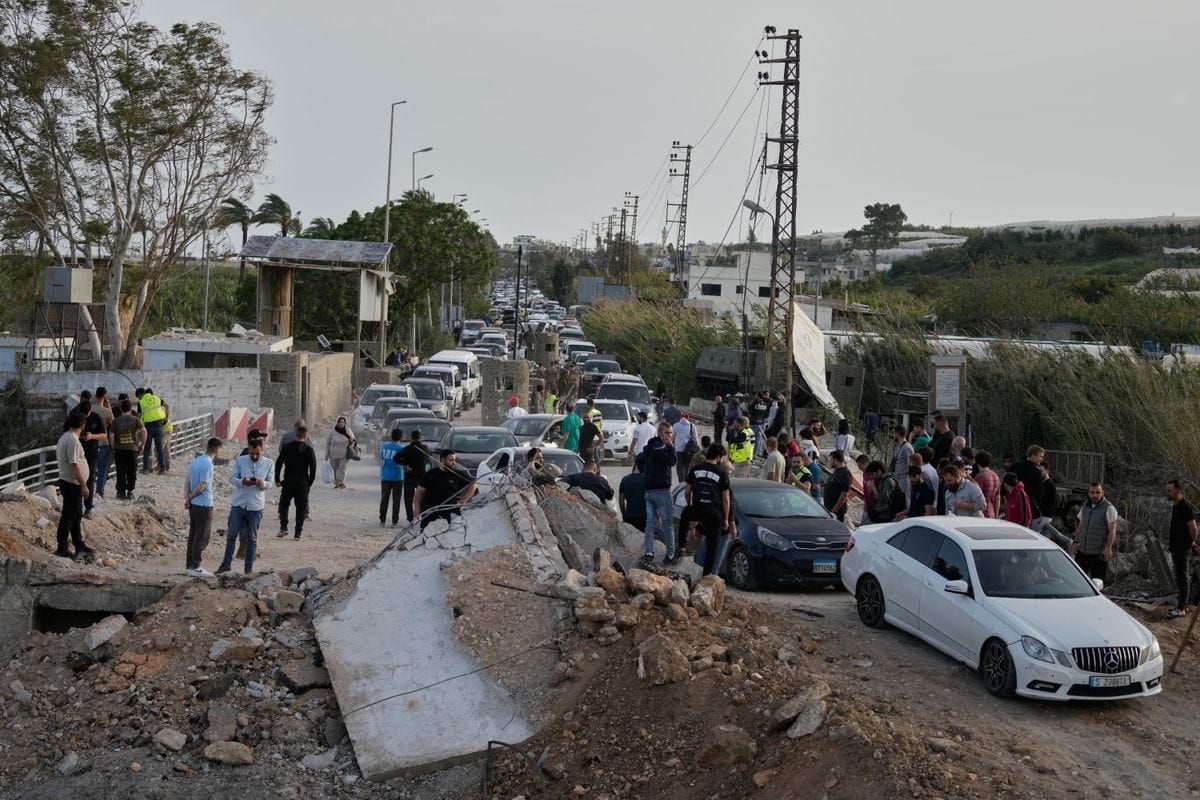
Those wars have targeted not just political adversaries and not just military capabilities and not even just civilians: "Beyond the horrific death toll, the US-Israeli strikes have destroyed schools, universities, hospitals, bridges, water desalination plants, police stations, oil refineries, and more." In Lebanon, Israel is openly implementing the Gaza model; its April 8 bombings killed more people than the Beirut port explosion which so severely tramautized the country a few years ago. In Iran, Trump has repeatedly threatened to destroy every bridge, every power plant, international law be damned. The US and Israel, in other words, have been directly targeting state capacity - degrading precisely the institutional resources which might hold things together in the face of chaos, death and destruction.
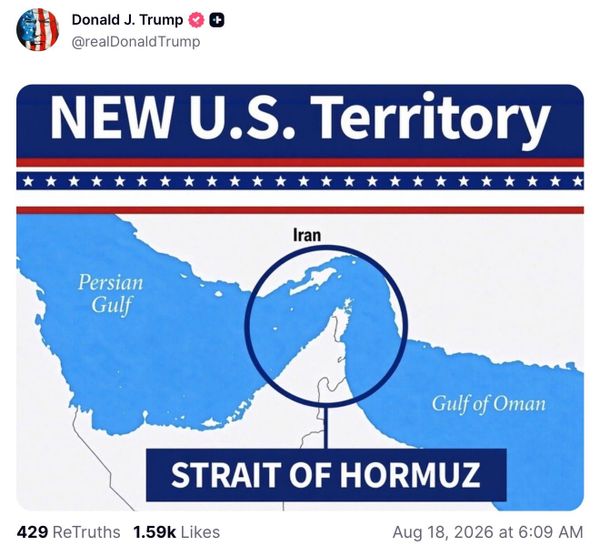
The economic and political fallout of the war is having a similar indirect effect on state capacity around the region. States such as Egypt, Jordan, Syria and Iraq which were already struggling with fiscal disaster and catastrophic governance now have to grapple with skyrocketing energy prices, disruptions to the food supply, and potential new waves of refugees with few obvious sources of external support. Iranian attacks and the closure of the Straits of Hormuz are inflicting previously unthinkable damage on the wealthy Gulf states, whose immunity from regional conflicts has been broken, whose seemingly infinite wealth is suddenly profoundly in question, whose environmental sustainability is radically in doubt. They are less likely to ride to the rescue or to finance reconstruction under such constraints and uncertainty.
And so, the Iran war has achieved the implausible, bringing me and Gause together on the urgent need to preserve and protect state capacity. It's not quite in the way Gause expected, of course – he did not have the United States cast in the lead role as the destroyer of state capacity in the way that I did. And it's not in the conditions that I developed my argument – the Arab states, especially in the Gulf, have gone from key forces undermining state capacity to desperate understudies watching the US, Israel and Iran wreak havoc. But under the current conditions, it truly has become urgent to prevent the region's states from failing under the ever mounting pressures for which the United States and Israel are squarely to blame. It's possible to see why this all looks acceptable to Israel, as I wrote last week explaining the comprehensive failure of its post-October 7 strategy. It's obvious that Trump couldn't care less about human costs or the struggles of anyone in the region that doesn't have billions of dollars at hand to bribe him, and equally obvious that Hegseth can't think beyond counting bombs dropped and targets destroyed. But it's still hard to understand how the Trump administration thinks the cascading collapse of the state in Iran, in Iraq, or across the Levant – will serve American, or anyone's, interests.