Israel's Road to Nowhere
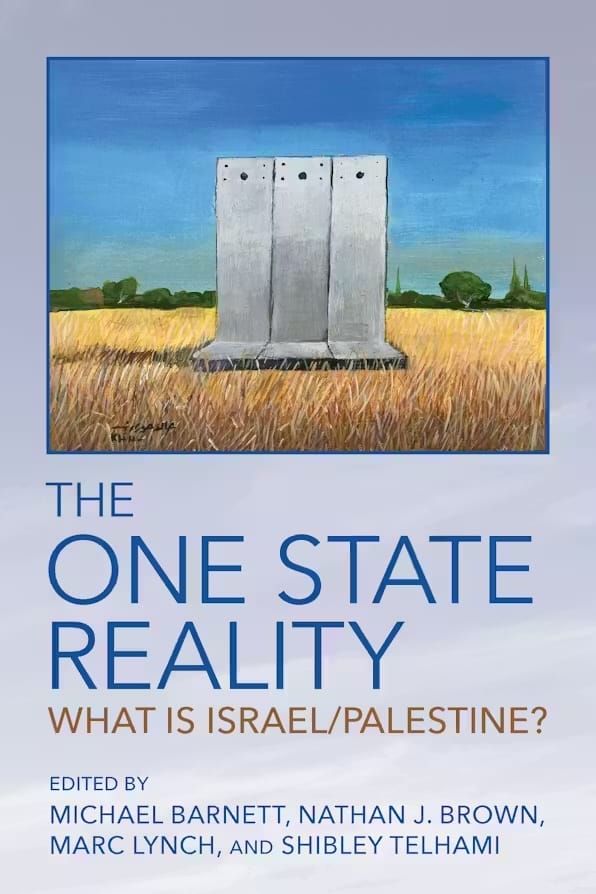
Shibley Telhami and I joined Ezra Klein in New York for his popular New York Times podcast to talk about our 2023 edited volume The One State Reality, our series of publications in Foreign Affairs about the end of the two state solution, and the harsh and deterioriating realities on the ground in the West Bank and Gaza. In his introduction to the episode, Klein looks back to our argument three years ago:
What they were saying then is that the hope of a two-state solution in the future had become a way by which many in America, particularly, avoided reckoning with “the one-state reality” of the present. That reality was not accidental. It was, and is, not intended to be transient. It was being etched into the land — in stone and cement, in settlements and checkpoints, in the construction of walls and the demolition of homes. That might have been a controversial claim when it was made. But what has happened since Oct. 7 has made it an undeniable reality.
The public discourse has come a long way towards recognizing Israeli policy for what it is and beginning to reckon with its implications. When we published "Israel's One State Reality" in Foreign Affairs three years ago, it set off a major firestorm. In a symposium the next issue, three major pro-Israel figures beclowned themselves by smearing us as antisemites, a charming sneak preview of the vicious response to the campus protests over Gaza. It's quite remarkable to now see it featured in the New York Times, and on one of the world's most popular podcasts, as obviously true, with the interesting questions being how we got there and where to go from here rather than whether reality is real.
I was absolutely delighted that Ezra hosted this conversation, and impressed by how his own reporting from Israel and the West Bank informed his shifting views on these topics. Please listen to the podcast conversation and read the transcript, as Telhami, Klein and I talk through some of the realities of political life in Israel and Palestine and what it all means.
Interested in how the Middle East got to this sorry state? Please check out my new book, America's Middle East: The Ruination of a Region.
This morning I also published a new Foreign Policy article arguing that Israel's post-October 7 regional strategy – best articulated in my view by some half a dozen similar articles by Amos Yadlin in Foreign Affairs over the last few years, by Netanyahu, and by a variety of IDF officials – has already failed.
It represents the failure of an ambitious government strategy of regional transformation through unfettered military intervention after the Hamas attacks of October 7, 2023. Its steady expansion of targets and the intensity of air strikes aimed not simply to manage conflicts but to end them: the total destruction of Hamas, the disarmament of Hezbollah, regime change or state collapse in Iran. In each theater, outright victory has eluded Israel despite unprecedented and extreme violence, the shattering of norms and international law, and the infliction of excessive human suffering. Netanyahu's claims of success based on degrading the capability of adversaries is in reality an admission of defeat— a return to the very doctine he hoped to abandon and a disturbing indicator of where Israeli policy may go in the coming days.
This failure is not because it didn't bomb enough. Far from it. Israel, like the United States in Iran, has not just enjoyed tactical success but strategic failure – those successful tactics are in fact precisely what has pushed strategic objectives ever further from reach.
As a result, Israel must now return to a strategy of conflict management, mowing the grass at infinitely higher levels of death and destruction without any path to the lasting resolution the new strategy had promised. The costs of repeated military campaigns have grown far higher than before, though, in ways that Israelis doggedly refuse to acknowledge. The horrors of Israel's war on Gaza have turned public opinion against Israel across much of Europe and the United States, while its reckless interventionism has convinced many Arabs that Israel should be seen as a threat rather than as a potential security partner....
That's why, I argue, that
in a fundamental sense, Israel's post-Oct. 7 strategy has already failed. For all the damage it has inflicted upon its enemies, Israel has not succeeded in eliminating any of them—not even Hamas. Its expansionism and extreme violence in Gaza and Lebanon have triggered a generational backlash among the Europeans and Americans which represent its most essential source of external support and have changed Arab perceptions of Israel's viability as an ally. Netanyahu's critics at home are right when they argue that he has led the country into endless and increasingly pointless wars, while offering no true alternatives to regional quagmire and international isolation.
There's a lot more about Israel's refusal to heed the importance of legitimacy and norms, how its approach contributed the emergent UAE-Saudi conflict, and the failure of Netanyahu's opponents to offer any real alternatives to the endless war they criticize. It's incredibly dangerous because in the face of strategic failure, the domestic political imperative is always to double down and escalate – with the implicit shifting of the goalposts from changing particular regimes or policies to (as Daniel Levy recently put it) the wholesale fragmentation and implosion of states and even entire subregions.
Read the whole article at Foreign Policy (paywall free).
Only you can... make America's Middle East: The Ruination of a Region a bestseller.
Finally, I wanted to share a video of a panel discussion I joined at the Arab Center DC last week. It was a very interesting and in-depth discussion, where I emphasized the degree of destruction and death that's already happened beyond calculations of winners and losers. I hope to write up some of my remarks and share them soon, but for now check this out – I can't figure out how to embed it, sorry, but you can find it at this link.
Interested in how the Middle East got to this sorry state? Please check out my new book, America's Middle East: The Ruination of a Region.