The End of America's Middle East
I have been bad about updating the blog this summer – forgive me, it has been very, very hot in Gainesville, and planning our move back to DC for the fall semester (more on that later) has taken up a lot of bandwidth. I let the podcast go on summer vacation, haven't updated the MENA Academy linkfest for a while, and have mostly been lying low and working to prepare things for the fall. I realize that I even forgot to blog about my Foreign Policy review essay of Eyal Weizman's outstanding new book Ungrounded, on Israel's physical destruction of Gaza.
So I'm delighted to share one of the things I was working on: my new essay in Foreign Affairs (gift link here), "The End of America's Middle East: Iran and the Last Gasp of a Failed Order." It is the distillation and updating of last year's book, America's Middle East: The Ruination of a Region, in light of the almost unbelievable catastrophe that is the US-Israeli war on Iran. Every day since I sat down to write, the region has offered more supporting evidence of the fundamental argument that we have reached the end of the core bargain which underpinned the post-1991 American-led Middle Eastern order. But unlike many elegaics for the rapidly collapsing regional order, I'm unwilling to pretend that that order was actually good for much of anything – certainly not for the vast majority of the people living in the region. As I put it leading off the essay:
"the architects of this war vastly exaggerated what military power could achieve, underestimated the capacity of adversaries to adapt, took for granted that allies would fall in line, and callously disregarded the lives of ordinary people. Washington’s misadventure was not an aberration so much as the ultimate expression of the inherent vice of its Middle East strategy."
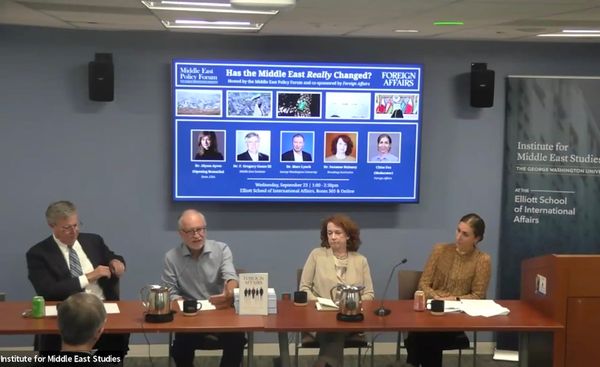
While it may look like the existing order will yet again survive the disruptions (a case made by the esteemed Gregory Gause in the same issue – come watch us argue it out in person in a panel also featuring Suzanne Maloney and chaired by Justin Vogt of Foreign Affairs at the Elliott School on September 23!), in fact this is a lot like Wile E. Coyote running on air before reality catches up. The British and French empires didn't disappear overnight after the Suez Crisis, but in retrospect their demise by then was inevitable; the same is true of the US after Gaza and Iran. As I put it:
"Facing an inconclusive war and an empowered Iran, the Gulf states may ramp up their arms purchases and their demands for renewed security guarantees, creating the illusion of continuity. But the old order is in fact giving way to something new. The 1956 Suez crisis is remembered today as the last gasp of British and French imperial power in the Middle East, but it took years to reach that inevitable end. American primacy will not disappear immediately, either, but long-building doubts about American power and purpose have passed their tipping point."
The piece ranges over the history and the consequences of post-1991 American policy in the Middle East, highlighting the core regime security bargain binding together the US, its Arab allies, and Israel, and how that bargain locked in brutal autocracy, generated intensely negative economic, political and security outcomes, and incentivized those same allies to disregard or even work against US priorities with little fear of punishment. One key part of this security bargain is that it was never really tested: for all the intense and expensive militarization of the region, few Arab states actually feared or expected either an Israeli or an Iranian attack. That's no longer the case. As I conclude:
"The dual crisis of Israel’s destruction of Gaza and the U.S.-Israeli war in Iran may seem like just another episode in this cycle. But in truth, these events together have dealt a death blow to the American Middle East. American support for Israel’s assault on Gaza, particularly under President Joe Biden, swept away any residual moral authority the United States could claim. Trump’s debacle in Iran has shattered the illusion of American military omnipotence. Both incidents have demonstrated to Arab states their lack of meaningful influence within the regional order and the diminishing returns of American security guarantees."
There's a whole lot more in this piece. Please read the whole thing in the new issue of Foreign Affairs, then go buy the book. There's an opportunity for real regional change in the wake of the disastrous US-Israeli war, and we need to start the public and private discussion about what that could look like and how to get there now. Trump, as I argue, is not capable of seizing that chance, but the next president might have a genuine opportunity to revise the incredibly destructive, failed approach to the Middle East that has guided every post-1991 presidency.