Political Movements in North Africa and the Sahel
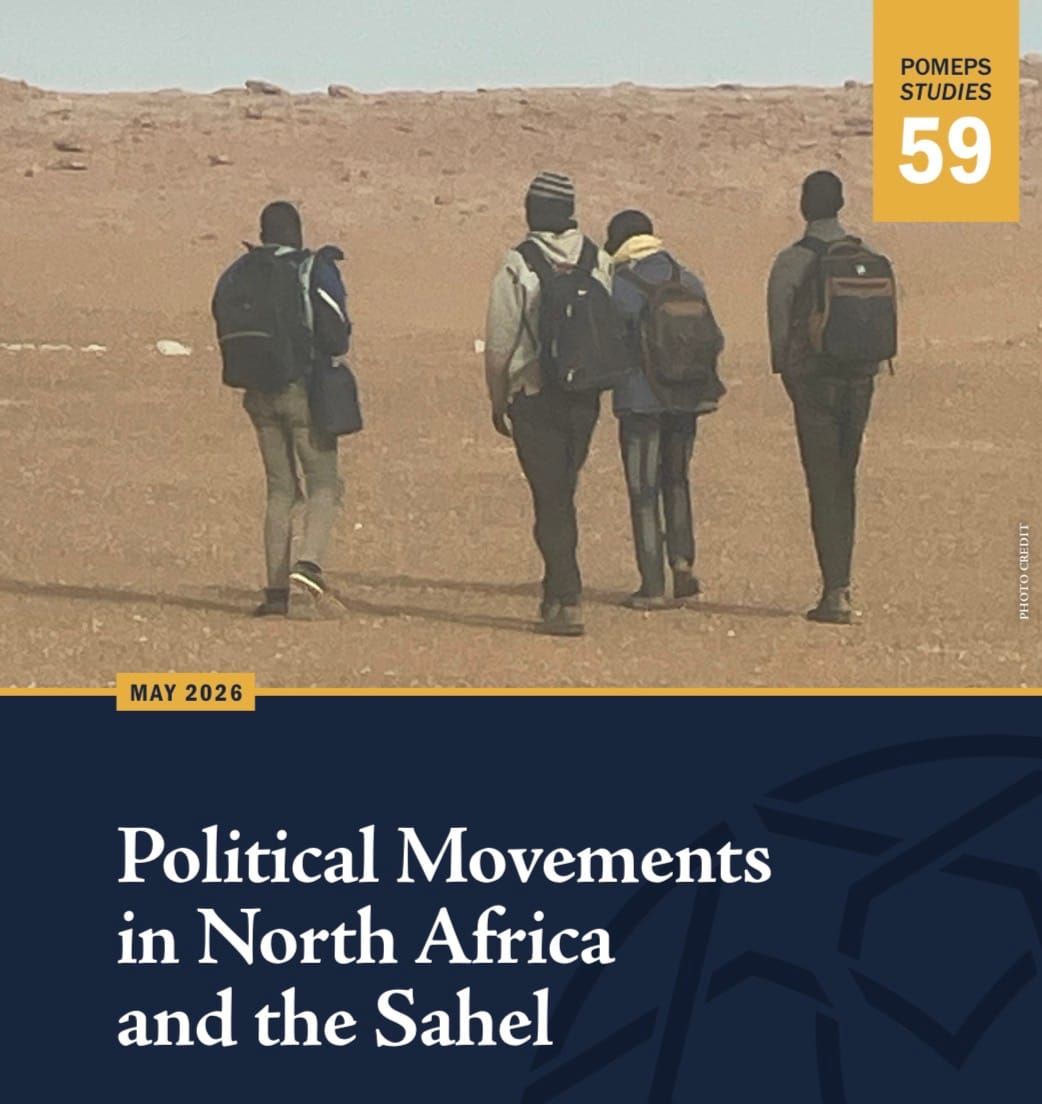
I'm delighted to announce the publication of POMEPS Studies 59 Political Movements in North Africa and the Sahel, available as a free PDF download. It is the product of a joint POMEPS-Pasiri workshop held in February at the University of Florida, organized by me and Ben Smith with the Center for Global Islamic Studies and drawing heavily on the faculty and students associated with the Center for African Studies (thanks Leo Villalon and Olivier Walthier!). It brought together a stellar group of more than a dozen young scholars, many from the region and all working on countries and issues spanning subregions often considered in isolation from each other. That transregional approach builds on a half decade of joint POMEPS-Pasiri work on breaking down artificial analytical divides between Africa and the Middle East (see below). The papers explore the dynamic political changes across these linked regions, including important questions about Islamist movements like Ennahda but also with a particular eye on processes and movements which often fall beneath the radar for not (yet) amounting to revolutionary political transformations.
My introductory framing essay is reproduced below in its entirety, including internal links to all the other essays. Check out my intro, and download the whole open access collection here!
Political Movements in North Africa and the Sahel
North Africa and the Sahel have undergone quietly dramatic and interconnected political transformations over the last fifteen years. Adam Branch and Zachariah Mampilly remind us that the Tunisian, Egyptian, Libyan and Moroccan uprisings of 2011 followed upon waves of political mobilization across the African continent.[1] Those revolutionary movements produced short-lived democratization followed by coups and fierce repression in Egypt and Tunisia, state failure and civil war in Libya, and effective adaptations by the Moroccan monarchy. Later waves of protest would hit Algeria and Sudan. At the same time, economic and political grievances, as well as deep frustration with civilian governance, led to a wave of both popular protest movements and military coups across the Sahel.
In February 2026, POMEPS and the Project on African Social Research organized a workshop hosted by the University of Florida’s Political Science Department Center for Global Islamic Studies to take stock of these dramatic changes. Ben Smith and I laid out a wide-ranging set of questions for a group of mostly junior scholars to begin a sustained conversation about the transforming political landscape of two closely connected regions which are too rarely put into direct conversation. How can we best explain the emergence of new social and religious movements, setbacks to democracy through military coup and political repression, and shifts in the landscape of Islamist and jihadist politics? And how can the rich empirical data emerging from those countries inform broader questions about political science and religious studies?
The decision to combine analysis of the Maghreb and the Sahel was intentional. The divide between the Maghreb and the rest of Africa was the product not of geographic necessity or long historical precedent, but rather French colonialism and its deep racism. The Sahara desert has never been a decisive barrier to the movement of people, goods, and ideas, any more than have bodies of water such as the Red Sea or the Mediterranean.[2] The Maghreb has always been a key destination and transit point for migrants emanating from West and Central Africa, while North African states have long engaged politically in their southern neighbors. Amazigh communities historically traversed a broad swathe of territory now divided among multiple postcolonial states, as have Sufi orders. Libya’s war and state collapse destabilized not only North African neighbors but also many of the African states to its south, contributing to the pressures and grievances which drove military coups, popular uprisings, and emergent jihadist movements across the Sahel belt.
For the last half decade, POMEPS and the PASR have been collaborating on transregional projects designed to break down artificial regional and subregional boundaries. This collection builds on our earlier publications, including POMEPS Studies 40 Africa and the Middle East: Beyond the Divides (2020), POMEPS Studies 44 Racial Formations in Africa and the Middle East: A Transregional Approach (2021), and POMEPS Studies 52 Race Politics and Colonial Legacies: France, Africa, and the Middle East (2024). The workshop draws heavily on the University of Florida’s formidable Center for African Studies, where many of the authors in this collection worked or studied; we thank Leo Villalón and Olivier Walthier for joining and guiding the discussions over the course of the day.
One set of papers focused on Islamist movements. Tunisia’s Ennahda has become one of the most studied and in many ways most interesting of the Muslim Brotherhood-style Islamist movements in the post-Arab uprisings era. In contrast to its Egyptian counterpart, Ennahda tried to forestall repression and democratic collapse by a politics of consensus and compromise. It failed. Ameni Mehrez weighs competing explanations for the decline of the Ennahda movement after its surprising rebirth following the revolution. She considers the role of “ideological rebranding, power sharing, and the party’s internal divisions”, demonstrating how the moderation and pragmatism which earned Ennahda international acclaim contributed to its internal schisms, failed to persuade Tunisians of its sincerity, and gave Kais Saied vulnerabilities to exploit.
Michael Schuster looks at the other end of the Islamist spectrum in Tunisia, the Salafi movement, to explore their parallel decline as well as co-optation by the Kais Saied dictatorship. “How could the same socioreligious current move so quickly from marginality to prominence and back to near-erasure,” Schuster asks, echoing questions asked by scholars of the Egyptian Salafi movement. His answer focuses on shifting political opportunity structures. The post-revolutionary opening allowed Salafi actors to localize their discourse, integrate social grievances, and present themselves as authentic moral representatives of marginalized constituencies.” Those efforts could not survive political polarization and shifting opportunities; as Schuster observers, “under President Kaïs Saïed’s renewed authoritarianism, Salafism has been simultaneously repressed and discursively absorbed by the state.”
That process of repression and absorption mirrors the experience of Salafis in Egypt, where a similar trajectory of surprising emergence after 2011 ended in retreat.[3] A similar trajectory could be observed for Islamists of all varieties in Mauritania, Baba Adou observes in his contribution. Official Islam looks different in Mauritania, Adou argues, where rhetorical co-optation of Islamic discourse and practice substitutes for weak state institutions. And, as Brahim Afrit shows, state co-optation and instrumentalization of religion goes beyond domestic political consolidation; it also plays out across the Sahel, at Algerian religious diplomacy conducted through local sufi orders in the Sahel and West Africa allows it to compete with Morocco for influence.
The decline of Islamist alternatives does not mean that political mobilization has faded, though. Tunisia and Morocco provide multiple examples of non-Islamist forms of political mobilization driven by political and economic grievances but often lacking effective organizations, leadership, or strategies. Hind Ahmed Zaki considers the ambiguous and contested place of Tunisia’s feminist movement in its frustrated struggle for democratrization, while Mariam Ben Slama highlights political mobilization in the face of decades of neglect and environmental catastrophe in the southern areas of the country. Alexandra Blackman demonstrates the intimate connections between Morocco’s drug policies, state repression, and Rif political protest movements. Mohammed Daadaoui explores the recent GenZ protest movement in the context of earlier waves of Moroccan activism and the growing tensions surrounding the political role of a monarchy. His analysis of the “king’s dilemma,” in which “the regime can no longer simultaneously dominate the political system and remain insulated from public scrutiny”, mirrors the political trajectory of monarchies such as Jordan and Kuwait.
Several of the papers explore Maghrebi connections to the Sahel and the different routes of political developments in that region. One key transregional force is the cultural revival of the Amazigh communities which do not align with postcolonial borders. Brahim Elguabli analyzes the turn towards Global Indigeneity discourse by Amazigh social movements in the early 1990s, which allowed them to confront the “politics of minoritization” by states and political systems which pushed them to the margins both culturally and politically. Salah Ben Hammou and Jonathan Powell analyze the military coups which have swept through the Sahel, focusing on civilian support for military interventions and the “buyers remorse” that follows. David Russell uses novel geolocation event data to offer fine grained analysis of the shifting strategies of armed groups in Libya — a particularly critical vector for destabilization of its neighbors from Sudan to the Sahel. Finally, Md Maniruzzaman Mamun offers a quantitative analysis of the travails of democratization in the region, noting that “the post–Arab Spring period has witnessed both a rise in mobilization and greater variation in its intensity. What explains the persistence and evolution of democratic mobilization in North Africa and the Sahel across these pre- and post-Arab Spring contexts?”
Taken together, the papers demonstrate an interconnected region where dramatic and sobering setbacks for democratic governance conceal significant societal and political ferment. This is a region very much in political motion, even as the destination remains far from clear. While Islamist movements are increasingly marginalized through repression, co-optation, and broader regional delegitimation, other kinds of social movements have continued to emerge to challenge corrupt and repressive regimes. Feminist movements, environmental movements, localized protest movements, labor movements, Amazigh revivalist movements, and leaderless youth movements all continue to push for meaningful change outside of formal institutional channels.
These movements may not look like the regime threatening mass mobilization of 2011, but that should not be taken to mean they are politically insignificant. Sudan’s 2018 revolution overthrew a long entrenched military regime, while Algeria’s 2019 Hirak may well have forced more significant political change had COVID not intervened. Morocco’s repeated waves of “non-movements” reveal a frustrated and alienated society for whose problems the regime has few solutions. Civilian support for military coups across the Sahel similarly show populations deeply frustrated with the status quo who despair of meaningful change through existing political institutions. Initial civilian support for Kais Saied’s populist overthrow of Tunisian democracy likely drew on similar social forces. That neither Saied nor any of the Sahelian coup regimes have been able to produce better outcomes suggests that the quest for change will continue.
[1] Adam Branch and Zachariah Mampilly, Africa Rising: Popular Protest and Political Change (Zed Books, 2015).
[2] Judith Scheele, Shifting Sands: A Human History of the Sahara (Basic Books, 2025); Brahim El Guabli, Desert Imaginations: A History of Saharanism and its Radical Consequences (University of California, 2025).
[3] Stephane Lacroix, Twilight of the Saints (Columbia University Press, 2025).