Resurgency and Warscape in Iraq
This Must Be The Podcast: Kali Rubaii
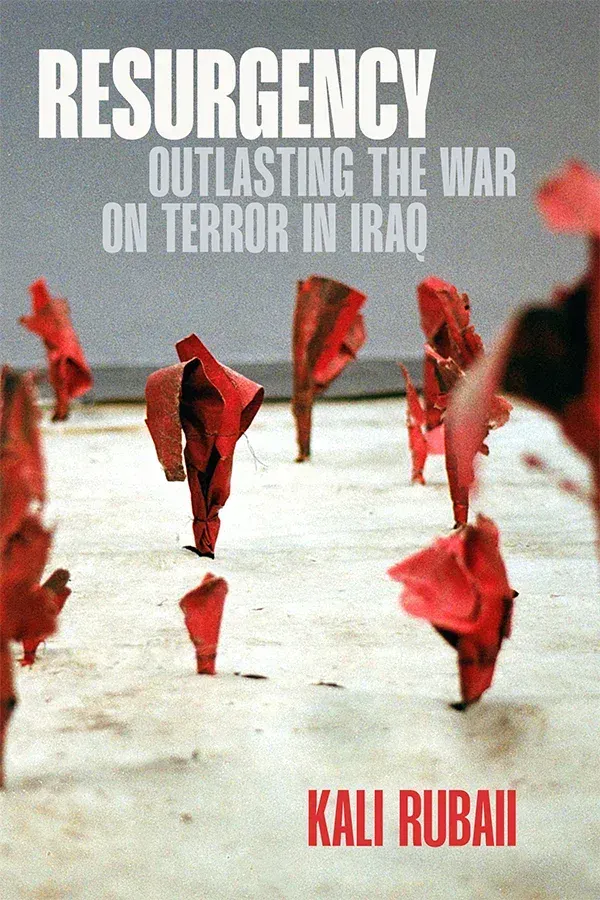
Resurgency, by Iraqi-American anthropologist Kali Rubaii, is one of the best books I've read about Middle East politics in the last few years. Based on years of ethnographic research with Iraqi farmers from Anbar, many of them displaced into Iraqi Kurdistan or elsewhere but still attached to their farms and homes, Resurgency presents a dramatically original reinterpretation of the nature of war and its longterm legacies – and a searing indictment of what America did to Iraq. It's an inspiration for my own current book project on the Middle Eastern warscape, and it's one of those books that I think should be very widely read beyond anthropology and specialists on Iraq. It details the realities of counterinsurgency from the vantage point of ordinary people, transforms notions of temporality and violence, and connects seemingly unrelated environmental, economic, political, and military phenomena in unique ways.
Last week, I invited Rubaii onto the Middle East Political Science Podcast to talk about her forthcoming book (due out July 17). I had read an early version of it for a POMEPS book workshop a few years ago, and she was a key participant in a series of workshops about warscapes that I had organized before conceptualizing my current book project. Listen to my conversation with Kali Rubaii here:
Rubaii's concept of "resurgency" reframes the vast literature and historiography of counterinsurgency by centering temporality and the long term shaping of societies by those seeking to not only defeat "insurgents" but to prevent even the possibility of organized resistance. This involves a wide range of tactics, some of them adopted in the face of immediate military exigency but others having longer term implications. Rubaii, like others writing in the warscape tradition, rejects stark distinctions between war and after, highlighting continuities in forms of domination and struggle: "military violation includes not only the initial shock of war but also the incapacitation of recovery from that shock through modes of coercion that curtail future uprisings by eroding social and physical terrains." This involves a wider range of strategies and interventions than just kinetic force:
"In Iraq, this colonial targeting of resurgency includes displacement, broadly; less than lethal violence that limits the power and meaning of people's lives and deaths; divide-and-rule tactics that erode unified resistance and limit mobility; widespread suspense and uncertainty that limit planning and future building; dessication that robs the land of its capacity to host and sustain lives... The effects are delayed, visible only when the scope of analysis of military coercion extends beyond the declared operational vectors and temporal reach of war."
Counterinsurgency in Iraq blends seamlessly into counterresurgency, as military tactics profoundly reshape society in ways that presumably make resistance less feasible. The mass displacements of the early days of the war didn't only create more ethnically/religiously homogenous areas, but also degraded the possibilities for cross-ethnic/cross-sectarian mobilization. The placement of T-walls and checkpoints in Baghdad and other cities didn't only prevent insurgent infiltration, it reconfigured urban landscapes in brutally effective ways that choked off social exchange and commerce across neighborhoods and created opportunities for invasive surveillance and control – while generating tremendous insecurity, fear, and risk for those attempting to cross checkpoints manned by sectarian militias which were not always easily distinguishable from official personnel. Massive bombardment left behind not only the obvious physical destruction, but the slow poisoning of the soil and water on which lives depended (see Munira Khayyat's brilliant book on south Lebanon on this dimension).
There's a growing body of research on Iraq, much of it fantastic, based on the exploitation of captured archives and, during periods of relative stability, research in Baghdad and across southern Iraq. Rubaii's research is different. It involved ethnography moving primarily between Iraqi Kurdistan and Anbar, sharing risks with her Iraqi interlocutors not only at checkpoints but by drinking the water poisoned by oil production and eating dates poisoned by spent munitions. Her theoretically rich analysis is punctuated by fieldwork vignettes written with stunning clarity, precision, and insight. Those ethnographic moments in turn inform her theoretical views – including the core concept of "resurgency", which she developed in large part through her ongoing conversations and observations of Anbari farmers.
Her concept of resurgency "is about how displaced farmers in Iraq struggle to outlast their occupiers by repairing war-made landscapes designed to preclude opportunities for their organized resistance, or even survival." What is especially interesting is that this is no celebration of "resilience" – a somewhat disturbing trend in studies of, say, Palestinian or Lebanese societies which sometimes glorifies and exaggerates the ways in which people withstand and overcome the rigors of occupation and war. But what Rubaii sees in her interlocutors goes in a different direction: "to say that'life goes on' after war is to dismiss the many deaths and damages that limit the capacity of people to recover, the kinds of 'double death' that threaten to usher extinction... the way life does go on is limping and full of ongoing grievance." We should never lose sight of the grim human toll of these wars, or take for granted that the targets of intervention, occupation and counterinsurgency will automatically adapt and thrive. People should not have to live like this. And we should not be surprised when those who do have little faith in promises of liberation, elections, official institutions, or media campaigns.
Resurgency is a devastating indictment of the American way of war. Rubaii views the toxic legacies of war and occupation as strategic and intentional in its destruction and degradation of civilian life, economic potential, and environmental capacity. "Less than lethal" forms of counterinsurgency may not kill quite as indiscriminately, but they are most certainly not meant to facilitate a full return to normal life: by "decentering death" they are meant to destroy the capacities and foundations for that normality in ways that ensure long term subjugation. She quotes an Iraqi doctor recalling life under U.S. sanctions in the 1990s: "I had to watch children suffocate to death from asthma. I knew how to solve this problem but I could do nothing, because they wouldn't allow us to import inhalers. The sanctions were a war." She relates how the Iraqis she spent extended time with "would become loquacious in giving account of violence done to them by Americans. Of note was the consistent pattern of incredible cruelty. Peoples' stories echoed with the derisive laughter of American soldiers enjoying inflicting pain and fear. Decades on, terror does not fade."
Experiences like that form the deep soil of my recent book America's Middle East. You should hear horrific echoes of Israel's genocidal destruction of Gaza in Rubaii's account of America's occupation of Iraq. You should see the US-Israeli war on Iran differently – the attack on economic and energy production facilities, the lack of distinction between civilian and military targets, the stand0ff strikes minimizing risk to Americans while maximizing the vulnerability of Iranians. And you should consider what kind of Middle East has been produced by these kinds of military interventions, what kinds of political attitudes and social structures and economic potentialities emerge from American "counterresurgency." This stunningly original, deeply researched, and fiercely critical book should be widely read not only by anthropologists or by Iraq specialists but by everyone thinking about war, American foreign policy, or the Global South.
Listen to my conversation with Kali Rubaii here.